
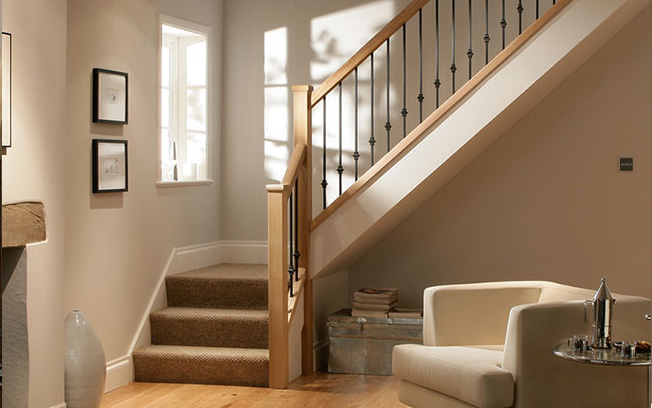
Maximising the space in the average family home can be an everyday challenge for homeowners. However, there is one, often overlooked area that can provide invaluable storage space, or indeed a room in its own right — the cupboard under the stairs.
Although there are numerous ingenious ideas for transforming this space, every home is different and certain renovations will naturally be more practical than others. Here, we talk to some experts in the construction trade to discover what is and isn’t possible in this space, and the best way to tackle different types of conversions. So, is it possible to open up the space under the stairs?
Yes, more often than not, it is possible to open up the space underneath the stairs as long as the wall is not structural or load bearing. Some of the best ways to utilise that awkward space underneath the stairs is to transform it into a downstairs toilet, storage area, utility room or extra alcove to the living room.
Keep reading to learn more about the practicalities of transforming the space under the stairs and where to find any important information you might need.
The practicalities of transforming the space under the stairs
Before you get carried away and start ripping off doors and knocking down walls, there are a few practicalities worth considering. Haydn Leon, owner of Stone 7 Construction, talks about the practicalities of converting this space:
What should a customer think about before they open up the space beneath the stairs?
First things first, you’ll need to clear everything out of the space and have a look at how much space there is once it is empty. Check the floor in case there is hidden access to a cellar and consider whether you’ll need to work around any fuse boxes or energy meters that may be housed in there.
It’s also worth noting that some semi-detached homes have a door on the outside of the house leading to a small storage space (traditionally used for storing coal). More often than not, this is the space beneath the stairs, so it may be necessary to brick up this external access if you are planning to open up the space from the inside.
Is it possible to remove the wall beneath the stairs to create an open space?
Yes, this wall is likely to be plasterboard and serves no structural purpose. Removing it shouldn’t be too difficult, unless it involves moving any fuse boxes or meters.
What is the best use of the space beneath the stairs?
Some great ways to transform the space underneath the stairs include:
- Downstairs toilet - This can add thousands to the value of a property and is therefore a worthwhile investment.
- Clever storage solutions (such as a cloakroom or storage space for bikes, pushchairs or books. You could even get creative and transform the space into your very own gin cabinet or wine cellar)
- Compact utility area
- Office
- Extra alcove to the living space
How easy would it be to transform a toilet into a storage space?
It is not advisable to remove a downstairs toilet as it may lessen the value of the property. However, if you have a downstairs toilet elsewhere, you will need to ensure that the plumbing beneath the stairs is properly capped off when removing any bathroom fittings.
Do you need any building regulations approval to transform this space?
If you are planning on installing a toilet, you will need building regulations approval. An inspector will check that you have correct drainage and properly installed electrical fittings etc. If you don’t have a window, you would also need to fit an electric ventilation fan.
Most storage-related conversions don’t require building regulations approval, unless plumbing or electrical work is involved or there have been significant structural adaptations.
Can I have a toilet under my stairs?
According to a recent survey, 46% of potential homebuyers cited ‘more than one toilet’ as being a priority, rating this with more importance than a garage, a new boiler or a dining room. Aside from being a desirable feature, a downstairs toilet can add as much as 5% to the value of a home, far more than the initial cost of the renovation.
To find out more about transforming the space under the stairs into a toilet, we spoke to Bathroom Guru Chris Martell. Here’s what he had to say:
What should a customer consider before installing toilet facilities under the stairs?
Once you have decided to install a downstairs toilet, there are four main factors to consider:
- Permission (building regulations and the local council)
- Budget (there's more than just a plumber needed for these jobs normally)
- Space available (head height is crucial underneath stairs)
- The existing plumbing and drainage (getting hot and cold water to the room and ensuring it can drain away as required)
Is it necessary to have existing plumbing in place to install toilet facilities?
Generally, it is not necessary to have existing plumbing in place when installing a downstairs toilet however, it should be considered at the outset.
The easiest place to site a downstairs toilet is near to the soil (drainage) pipe, which is normally positioned externally. In semi-detached and detached properties in the UK, this often makes it relatively easy to install a toilet under the stairs, as the soil pipe is often on the side of the house. Hot and cold pipework is normally picked up from the kitchen sink (and run to the new toilet under the floor or beneath kitchen units) or from the bathroom above.
Roughly how long would it take to transform an empty space into a toilet?
Generally, there is a lot more involved than simply hiring a plumber for a couple of days. This is where the benefits of using a turnkey provider come in handy. For example, simpler jobs where the space already exists and plumbing is straightforward may take a plumber a week. Alternatively, more complicated jobs involving many more tradesmen may take two weeks or longer.
Typically, a job may involve:
- Knocking through rooms and building up floor levels
- Bricking up coal shed doors
- Relocating a boiler
- Digging up the driveway to run drainage pipework
- Replacing an old cast-iron soil stack
- Moving utilities (with third party suppliers) such as gas metres
- Building, insulating and boarding new studwork
- Fitting a door frame, hanging a door, fitting skirting and architraves
- Extensive electrics (fan, lights, switches, underfloor heating etc.)
- Plastering
- Painting and decorating
- Plumbing
Is it still possible to install a toilet if the stairs have a shallow pitch?
This depends on the layout and where you intend to site the toilet, sink and so on. As a rule of thumb, the best solution in terms of head height is to put the toilet under the stairs (with the cistern facing the foot of the stairs) rather than the basin.
Top tip: If you can stand in front of the toilet without your head touching the ceiling, normally you will be able to sit on the toilet and get back up easily enough without banging your head on the sloping ceiling above.
Do you have any tips for customers whose space is limited?
For those who have limited space, we recommend that you use the space left at the foot of the stairs for storage that you can access from the hall. It’s also worth considering storage space within the room itself to ensure that necessities such as toiletries, spare toilet roll and cleaning products are kept out of sight.
Here are some of our top tips for maximising space:
- Install a wall-hung (back-to-wall) toilet - These reduce the amount of space that toilet pans take up as the cistern is effectively taken out of the room.
- Use wall-hung basins or vanity units suitable for cloakrooms - These will often have a smaller footprint than their bathroom counterparts, and being lifted off the floor will maximise the feeling of space.
- Corner basin units are great if space is tight.
- Maximise natural light wherever possible by adding an obscured window or large mirror. This will reflect the light and create a feeling of spaciousness.
- Hang doors so that they open outwards - This means that you won’t be awkwardly shuffling around the door to get in and out.
- Underfloor heating - This will maximise space as you won’t have to install a towel radiator.
Integrated storage
Modern living comes hand-in-hand with lots of ‘stuff’ — more stuff than we generally know what to do with. As a result, it can be a struggle to neatly house all of our belongings without our homes appearing as if they are bursting at the seams.
The space under the stairs is the perfect place to store all manner of items, either as a traditional closet/cloakroom or with integrated drawers and cupboards that use every inch of the area.
Michael Muldowney from Avar Furniture offers his advice on making the most of this often-wasted part of the home:
What should a customer consider before installing storage in the space beneath the stairs?
The first factor you should consider is whether there is anything under the stairs that requires access. You would be surprised how many people didn’t know that the stopcock valve to shut off the mains water was under their stairs.
Do you find that some under-stair spaces work better as a walk-in closet with integrated storage inside (as opposed to drawer storage accessed from the hallway)?
Every job is different, depending on the requirements of the client and what we can achieve in the space. My suggestion would be to have pull-out storage units towards the bottom area — the most awkward area to access — and keep the tallest part for coat-hanging storage.
What alcove storage do you recommend for the space beneath the stairs?
Some people just want closed-off storage to keep the hallway clean as they enter the house. Others prefer to create a feature of the space, from an office-type desk area, to a relaxing reading area with a sofa.
What type of storage gives customers the most amount of usable space?
When it comes to giving customers the most space, it is all about requirements. For example, if you have a lot of shoes to store, it would be better to have drawers as opposed to shelves, so that you can use the full depth of the staircase. Alternatively, if you require more coat storage, we would recommend cupboard storage with hanging rails.
Is there any advice that you would give to customers who were considering transforming this space?
Remember to do your research into the company who will be carrying out the work and think about what you want to achieve. Lastly, if you decide on having drawers, don't use runners with low weight restrictions.
Transform the space underneath your stairs with Jackson Woodturners
At Jackson Woodturners, we are passionate about utilising that awkward space under the stairs. With our team of stair experts on hand, we can advise and help you plan and design this area to make the most of the space you have. We encourage creativity and innovation when it comes to designing your staircase, which is why we offer such a range of different stair parts and materials.
With trade prices available to all, we can help you build your staircase project efficiently and affordably. Our price promise guarantees that we’ll beat any like-for-like quote.
Get in touch with us today for more information about your up-and-coming stair project.


