Complete guide to wooden handrails
Wooden handrails have a classic look, which means they never go out of fashion. They have several benefits, making them a popular choice with homeowners looking to update their stairway. Wooden handrails are also available in a range of prices, meaning everyone can find an option to suit their budget, and they’re available in a wide range of style, materials, and finishes. So how do you choose the right wooden handrail?
To choose the right wooden handrail, first choose the overall style of your staircase, whether it’s modern, traditional, minimalist, or open for example. Once this has been decided, you can then choose the material, shape, finish, and accessories to ensure that it fits with the overall look and feel of your staircase.
Before buying a wooden handrail, it is vital to understand the benefits of the different types of woods and designs. Here, we provide a complete guide to the different woods and designs available, with advice on treating and cleaning wooden handrails.
Click on one of the links below to jump to that section:
- Types of wooden handrails
- Do wooden handrails go with glass?
- What is the best wood to use for handrails?
- What is the best handrail shape?
- How do I choose a handrail?
- What is the best handrail finish?
- How to clean a wooden handrail
- Frequently asked questions
What types of wooden handrail are there?
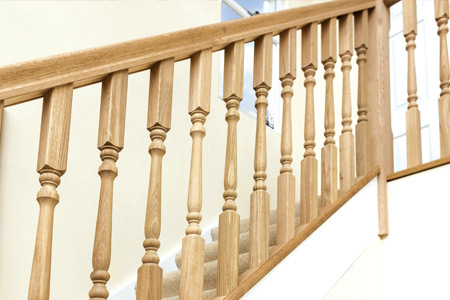
Oak and pine are two of the most popular types of wooden handrails for stairs and are at different ends of the scale when it comes to price and durability.
- Oak is highly durable hardwood and can therefore be more expensive.
- Pine is a softwood which is less durable but far more affordable.
- You can find out more about the difference between hardwood and softwood and the benefits of both by reading our guide Hardwood vs softwood: which is best for your wooden stair parts?
Are you choosing between oak and pine handrails? Read our guide to oak vs pine handrails.
Oak handrails
Oak can make a staircase look beautiful, but a solid oak balustrade can be expensive. You can save money without compromising on style by combining an oak handrail with a white primed newel post and spindles to give the illusion of a solid oak balustrade. White primed stair parts are made from either birch or poplar so are more affordable than oak. You can add a wall-mounted oak handrail, such as mopstick handrail, to your staircase to complete the look.
You can shop our complete range of oak handrails and oak stair parts here.
Hemlock handrails
Hemlock handrails are similar to pine but this softwood is more durable and has a uniform, knot-free grain.
Handrails such as this hemlock HR handrail 41mm groove can be finished by varnishing, waxing or painting, and come with a groove to allow a spindle to be fitted.
Walnut handrails
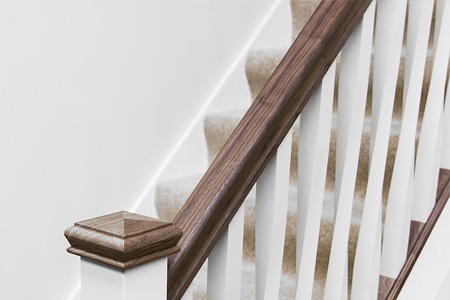
Walnut handrails are very dark and the rich colour of this hardwood makes a luxurious and striking addition to any hallway. Again, if you’re looking for a way to make a balustrade look more opulent, you could combine a walnut handrail with white primed spindles to give it a high-end finish at a much lower cost. The striking contrast between the dark walnut wood and white spindles is particularly eye-catching.
View our complete range of grooved and ungrooved walnut handrails here.
Ash handrails
Ash is another option for a hardwood handrail—the wood’s close grain makes it ideal for creating sturdy balustrades. Ash is a very light wood in colour so it can help brighten up dark hallways and works wonderfully with glass panels.
This ash HR handrail has a 41mm groove, which will allow a 41mm spindle to be fitted into the groove. Designed in a simple, elegant style, this handrail will suit most staircase styles.
You can shop our complete range of ash grooved handrails and ash ungrooved handrails.
What wooden handrails to go with glass?
These handrails tend to be more angular and feature a groove that the glass panels are fitted into, or are ungrooved and designed to have brackets fitted onto them, such as the Elements With Glass range.
If you prefer a more rounded wooden handrail then the Fusion range from Richard Burbidge combines the warmth of an oak, dark hardwood or walnut mopstick handrail with contemporary glass.
What is the best wood to use as a handrail?
Oak is the strongest and most durable type of wood for a handrail, however it is often the most expensive choice. However, if you’re looking for a long-term investment and like the look and style of wood with warm undertones – we recommend choosing oak.
Hemlock, though not quite as durable as oak, is one of the strongest woods to choose from in terms of durability. Although a softwood, hemlock is very dense, which means that it is a very strong wood, ideally suited to use in handrails.
Ash, on the other hand, is another very strong option - however it is less water-resistant than oak. Pine is also a fairly durable option, however can show scratches and dents over time. Nevertheless, pine has a close grain that makes it a considerably strong option.
Walnut is a premium hardwood and is an extremely good option for handrails; however, it is not ideal if you have a small budget.
Shop our complete range of wooden handrails for stairs.
What is the best shape for a handrail?
Wooden handrails come in a range of different shapes and styles. Which one you choose will depend mostly on the overall feel that you’re aiming for, such as choosing a cottage loaf handrail for a traditional staircase. Here we’ve broken down the main handrail styles and how to choose them.
Wall-mounted wooden handrails for stairs
Wooden pigs ear handrails
If you’re looking for a handrail that fits flush to the wall then consider fitting a pigs ear handrail. These wooden handrails don’t require brackets and are instead fitted directly to the wall and secured in place with screws. You can then fill the screw holes with tapered cross grain pellets (small pellets of wood designed to fill drill holes in wood) and sand the end of the pellet down once in place for a smooth finish.
Pigs ear handrails are a good choice if you have a narrow stairway as they fit close to the wall and they are generally chosen for a traditional staircase.
Shop our complete range of pigs ear handrails here.
Wooden mopstick handrails
Mopstick handrails are named because of their resemblance to long, round wooden mop handles. However, the name is slightly misleading as these handrails aren’t fully circular and instead have a flat bottom to attach brackets to. Mopstick handrails are available in several different types of wood and allow for a more decorative finish as you can add fittings such as end caps and brackets to personalise the handrail.
For more information on how to fit a mopstick handrail, read our guide, How to fit a mopstick handrail.
Are you looking for your ideal mopstick handrail? View our wide range of mopstick handrails here.
Wooden HR Handrails
The HR handrail is generally used for a modern staircase, and looks equally good sitting atop stair spindles as it does attached to the wall with brackets. These are available in a range of materials such as hemlock, oak, and ash.
Shop our full range of handrails to find out more.
Cottage Loaf Handrails
This type of handrail is typically used for traditional staircases, and is most popular in light wood materials such as pine and oak. The wood can then be finished to create a deep, darker shade that fits perfectly with highly decorative balustrades.
Wooden handrails for balustrades: popular styles
Modern handrail designs include mopstick handrails, glass grooved handrails to be used with glass, metal wall-mounted handrails, and HR handrails. You can also style a modern staircase by combining wood with glass or metal.
If you want a more traditional handrail style, the cottage loaf handrail is a popular traditional handrail. Woods you can use to create a more traditional feel include dark hardwood and walnut.
If you’re shopping for wooden stair parts for your staircase, you can view our complete wooden stair part range.
How do I choose a handrail?
As well as strength, durability, appearance and cost, there are some other essential factors to consider when choosing a handrail, such as the size of the handrail and the overall aesthetic you are going for.
You also need to make a choice between grooved handrails and ungrooved handrails. Grooved handrails are a perfect choice if you are wanting wooden or metal spindles, and they allow spindles to sit within the groove of the handrail. However, if you’d prefer to use glass panels, ungrooved handrails or glass grooved handrails would be a better choice.
What is the best finish for a wooden handrail?
As the majority of handrails come unfinished, you’ll also need to consider how you’d like to finish it. This will depend on the finished look that you’d like to get, what materials you’re matching it with, and how durable you want it to be.
Hardwax oil
At Jackson’s we recommend applying Treatex Hardwax Oil to wooden handrails which is quick-drying and hardwearing. Hard wax oils contain a blend of oils and waxes designed to protect wood including linseed oil, sunflower oil and beeswax. Applying hard wax oil makes wooden handrails stain-resistant and gives a lovely smooth finish to the surface.
Oil
If you prefer a more traditional approach to treating wood, you could apply two or three coats of linseed or teak oil and then apply a layer of wax. Danish oil is a mixture of oil and varnish so is more hardwearing than regular oil but not as hard wearing as hard wax oil.
Wax
Finishing waxes give wooden handrails an ultra-smooth surface and add an extra layer of protection to the wood. Wax can be easily reapplied as and when needed, without having to strip the handrail. You may want to apply a coat of wax to your handrail after oiling it to give it a shine.
Varnish
Varnish contains resin, drying oil, and a thinner to create a clear finish on wood. You can apply it after oiling the handrail and once it’s dried, varnish will protect against spills. The downside of varnish is that it can dull overtime and it can be tricky to apply, with air bubbles being a common issue.
Stain
If you want to match the look of your wooden handrail to your existing spindles, newel post, stair treads and risers, then you’ll need to apply a stain before treating the wood. You’ll need to apply a coat of sanding sealer to softwood handrails, such as pine, before applying a stain as softwood doesn’t stain very evenly.
It can be tricky to colour-match wood so use a tester pot to apply a small amount to the underside of the handrail and allow it to dry so you can get an accurate impression of the colour.
Once you’re happy with the colour, you can apply the stain to the rest of the handrail and allow it to dry before sealing the wood with varnish. Staining wood simply changes the colour of the wood and doesn’t provide any protection, so you’ll need to finish the wood with wax or varnish.
How to clean wooden handrails
You can easily remove oil and dirt from a wooden handrail by cleaning the surface with a baby wipe. If a baby wipe doesn’t remove all of the dirt, dip a cloth in equal parts water and vinegar to remove any stubborn dirt then remove any residue with a clean, damp cloth.
Alternatively, use a cloth dipped in a solution of washing-up liquid and warm water to clean the handrail.
If your handrail has a wax finish, then you could apply another coat of wax after cleaning it to give it a lovely shine.
To find out more about cleaning wooden handrails, visit our full guide here.
If you want to install a handrail and are unsure about what height it should be, read our guide to handrail height building regulations.
Wooden handrails for stairs from Jackson Woodturners
At Jackson Woodturners, we hold the largest collection of stair parts anywhere in the UK. Plus, the majority of our products are held in stock, meaning that you can get fast delivery on the perfect parts for your next staircase project.
We love to help our customers build their dream staircase, so if you’re not sure which handrail is right for you, get in touch with a member of our helpful team so that we can point you in the right direction.
Wooden handrail FAQs
How do you paint an oak handrail white?
It is possible to paint an oak handrail white, but sanding and preparing the wood is an essential part of this process. You will need to take extra care to make sure this is done to a high standard, to ensure that no colour comes through in the finished result.
How do you refinish an oak handrail?
To refinish an oak handrail, you will need to strip the wood before preparing and priming it. Then you can stain and finish the wood to your own aesthetic tastes.
Should you paint or stain your wooden handrail?
Paint is a great way to freshen a handrail or balustrade, but staining tends to last for longer and be more resilient over time.
What is the best paint for wooden stairs?
When it comes to wooden stairs, it is important to use a primer which you can then paint over with semi-gloss paint. This tends to be harder wearing than other paints.
What colour should your wooden handrail be?
Your handrail should fit in with the overall aesthetic of your home. It is generally a good idea to go with a neutral colour such as white or appreciate wood’s natural appearance, but you can also add a pop of vibrancy to make your handrail a feature.
How much does a wooden handrail cost per foot?
The cost of a handrail is most dependent on the type of wood that’s chosen. It can also depend on the style of the handrail too. To get an accurate estimate, check our handrails pages to see exact prices.
Is it a legal requirement to have a handrail on stairs?
It is a legal requirement to include a handrail for stairs with three or more steps. If your staircase is less than 1000mm wide, you need to have a handrail on at least one side. If it’s wider than 1000mm, you’ll need a handrail on both sides.
What is the correct height for a stair handrail?
The handrail should be between 900mm to 1000mm above the highest point of the staircase’s steps. Make sure you account for the angle of the handrail. You will need to measure from the outward tip of the step’s tread.


