

How to sand stairs
When sanding and painting your stairs, you could choose to go down the professional route and get a seasoned pro to do it for you. With this being said, these are fairly straightforward tasks that can be completed by someone with no experience. Doing it yourself will save you money and help you get it exactly how you want it to look.
So how do you sand stairs? To sand stairs, you should first remove any carpet and clear the area of nails, staples, dust, and debris. Begin sanding the steps from bottom to top, going with the grain of the wood. Then sand the spindles and handrails by wrapping it in long strips of sandpaper and running it back and forth.
Read on to find out more about the best way to sand stairs, how hard it is to sand stairs, what tools you need, and whether it’s necessary.
What is the best way to sand stairs?
Sanding stairs can be a daunting prospect for those that haven’t done it before. With such a large area to work with, where do you start? We’ve created this step by step guide to help you find the best way to sand your stairs.
Preparing the stairs
Before beginning the sanding process, there are a few steps to take to prepare. If your staircase has carpet that you’re looking to replace with paint, you’ll first need to pull up the carpet and ensure that there are no staple or nails left poking out from the wood. Removing these ahead of time will save you a lot of time and effort later on in the process.
Unsure how to remove a carpet from your staircase? Our how to paint stairs with carpet guide goes into detail about how to remove your carpet before painting.
Clean away debris
It’s best to sweep or hoover the stairs to remove any loose dust or debris that might have collected over time. Dust won’t necessarily impact the quality of your sanding, but it could make visibility difficult and result in missed sections. Debris such as small stones or pieces of wood from pulling the carpet out could get dragged along underneath the sandpaper and create scratches in the wood. It’s always best to make sure you have a clean slate to work with.
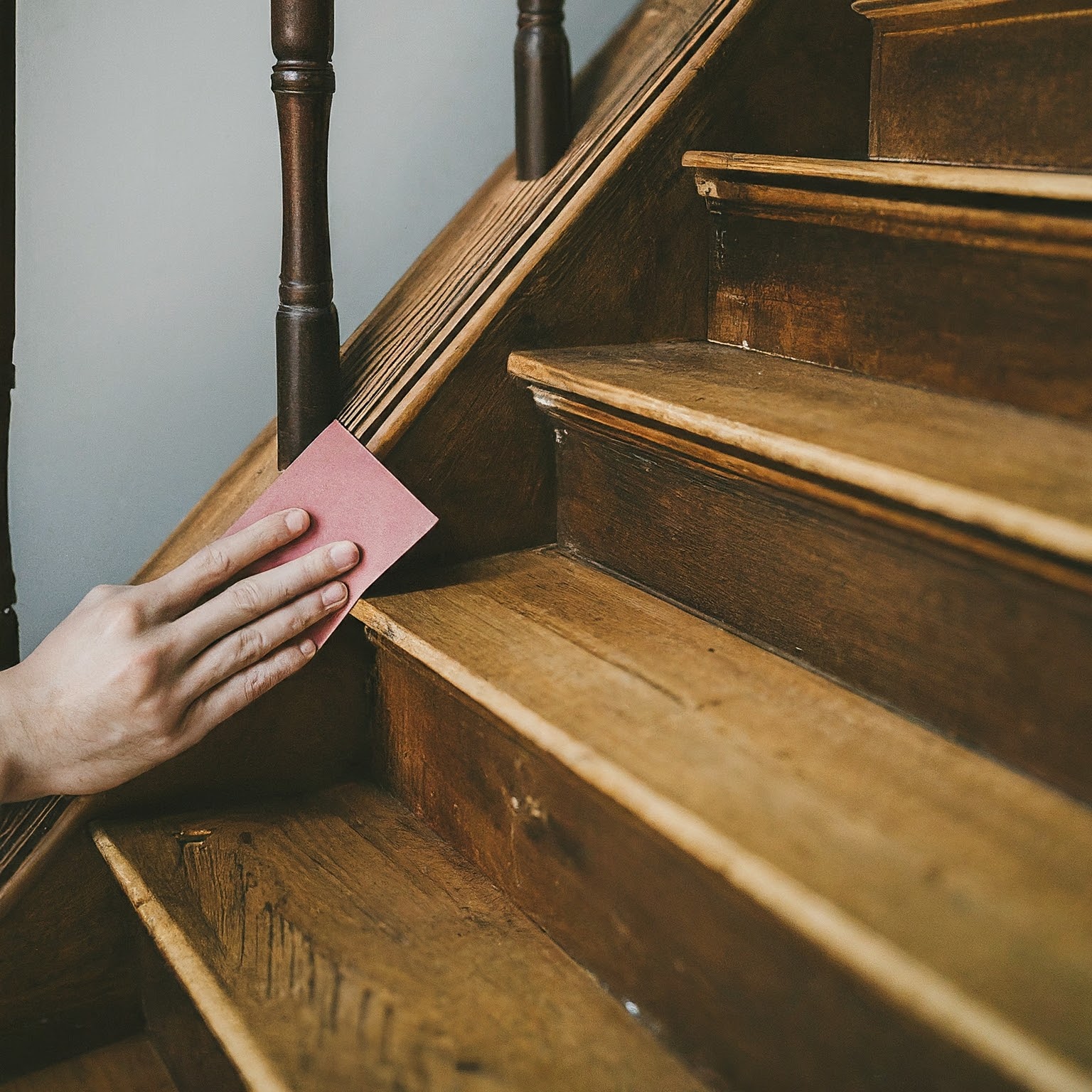
Sand the steps
Once the stairs are prepared, you can start sanding. Start with the steps and use a heavy-duty sandpaper. If you have access to one, an electric hand sander will make the job a lot faster and easier at this stage. Follow the grain of the wood to ensure you get into the cracks and remove all of the old paint or varnish.
If your base rails are visible on the outside, you’ll most likely be painting these too. You can sand these with a medium-fine sandpaper, such as a 120 grit.
Make sure you wear a dust mask and goggles to protect yourself from the dust and debris being created. This is particularly important if you’re using an electric sander as these will expel a lot of dust.
Sand the spindles & bannister
While it’s okay to use an electric sander for the steps, spindles should always be sanded by hand. This is because electric sanders won’t be able to maintain the curvature of the spindle.
The easiest way to complete this step is to trim the sandpaper down into long strips that can wrap around the complete spindle. Once you wrap it around, you can then run them up and down the length of the spindle in one smooth motion, sanding the entire outline in one go.
This technique should then be used on the handrails and other sections of the staircase that can’t be reached with an electric sander.

Check for missed patches & holes
Once you’ve finished the entire staircase, make sure to look over your work and ensure that you’ve not missed any sections. Painting over these missed patches will result in the paint peeling away a lot faster than the rest.
At this point you should also check for any holes in the wood that you want to fill. Filling the hole will make them smooth, so once the paint goes on you won’t notice the difference. Fill the holes with a wood filler like this pine filler and wipe them smooth before leaving it to dry. Once dry, you’ll need to sand this area again to provide a more adhesive area for the paint.
Clean the area
Before painting you’ll need to sweep or hoover the staircase again to remove all of the dust created during the sanding process. Otherwise, once you paint the area the dust will act as a blocking layer that stops the paint from sticking to the wood. It will also mix into the paint which will change its texture and look.
Our top tip
Make sure you start from the lowest point and make your way up the staircase. As you sand, dust will drop down from the area you’re working on to the area below. This will make it hard to work with if you go from top to bottom, because you won’t be able to see the section that you’re working with as easily.
How hard is it to sand stairs?
The overall difficulty of the task depends on the style of the staircase, the individual parts of the staircase, what material it’s made from, and how new or old it is. To learn more about the individual parts of your staircase, read our stair parts identification guide.
The style of the staircase matters because certain styles will be much more intricate and complicated than others. Sanding stairs will be much easier if you have perfectly smooth spindles or no spindles at all when compared to detailed spindles that will be difficult to sand.
Some materials will also be easier than others. This is mainly due to the toughness of the material adding physical strain to the task. It can also depend on the paint or varnish that needs to be removed.
With older stairs that have a lot of wear, you might need to be more careful with the wood to stop it from snapping pieces away. It can also be more difficult to get a smoother look if there are already chunks missing, and you’ll need to spend more time filling holes and resanding them.
Overall, a novice can easily complete the job of sanding their own staircase, however some staircases will take much more time and need more attention to detail.
What tools do you need to sand stairs?
Sanding stairs requires plenty of tools to complete the whole job. It’s best to gather these in advance so that you can finish sanding the staircase in one go, instead of having to go purchase the next item in between sanding. Tools you will need:
- A hammer or pliers to pull out nails and staples
- Wood filler
- Dust mask
- Safety goggles
- Cleaning equipment (sweeping brush, hoover, cloth, soapy water)
- Electric sander (if you have access to one)
- Sandpaper of multiple grits
The grit of the sandpaper that you should use will depend on the section that you’re sanding. You’ll need multiple grits to complete the entire staircase. We’ve broken down the sections of the staircase below.
Steps
The steps are the easiest to complete because they’re flat. We recommend sticking to around an 80 grit sandpaper for the treads and risers of the steps. You can also use an electric sander here if you have access to one.
Base rails & sides
Along the sides and base rails of the staircase you will need to use a medium-fine sandpaper such as a 120 grit. This section should be completed by hand instead of using an electric sander.
Spindles & handrails
For the spindles and handrails, you will need to use a similar sandpaper grit as the base rails. However, for this section you will need to cut the sandpaper into strips that reach around the width of the spindles. You should never attempt to use an electric sander for the spindles as it can deform their curvatures.
Do I need to sand stairs before repainting?
While painting directly onto your stairs without sanding will theoretically work, the finish won’t be what you’re hoping for, and it won’t last as long as if you’d taken the time to sand it first.
In order to get the best results possible, you will need to adequately sand your stairs. This will not only make it look and feel nicer, but it will also create a more adhesive surface for the primer or paint to stick to. This will make your painted stairs last for years with much less maintenance.
If you’ve ever seen paint peeling away from a surface after a while, this is most likely a result of painting on an unprepared surface. While it saves you time in the process, you’ll often need to redo the entire process multiple times due to the paint peeling away from the surface.
For more information, read our guide on how to prepare your stairs for painting.
Prepare your stairs for painting with Jackson Woodturners
Here at Jackson Woodturners, we understand how important it is for you to create the staircase of your dreams. Our team of stair experts are always on hand to help with any question you may have. We also offer a range of stair products that can help you in your sanding process, such as our high quality wood filler.
We offer trade prices to all to enable you to create your perfect staircase efficiently and affordably. Why not get in touch with a member of our expert team today for more information.


