
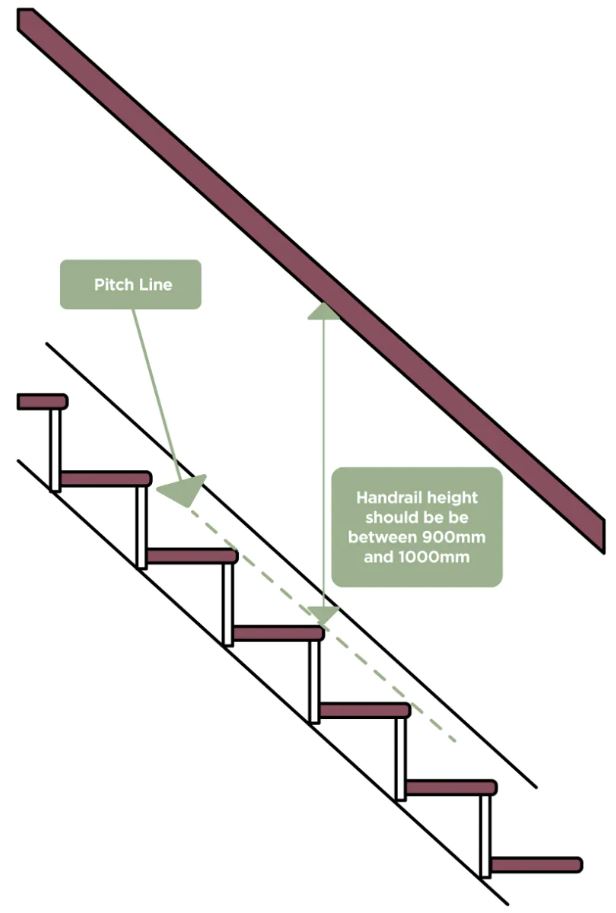
A stair handrail not only enhances the look of your staircase but also provides support and safety to those using the stairs. However, to ensure stair handrails provide the best support, they must be fitted in accordance with UK building regulations. So, what is the correct stair handrail height?
In the UK, Part K of the Building Regulations states that the top of a handrail should be between 900 mm and 1000 mm above the pitch line of the stairs, or the floor for landings. The pitch line is a virtual line that runs along the top of the stair nosing.
Keep reading for a more detailed explanation of the building regulations concerning stair handrail height, other important information you need to be aware of when renovating your staircase and how Jackson Woodturners can help.
Click on one of the links below to jump to that section:
- What is the correct stair handrail height in the UK?
Find out what height a stair handrail should be installed at, in the UK. - How to measure the height of a stair handrail
Discover how to accurately measure the stair handrail height. - What height should a handrail be on a landing?
Find out what height your handrail should be on a landing, and if this is different to the rest of the staircase. - What other building regulations apply to stair parts?
Learn what other building regulations apply to stair parts.
What is the correct stair handrail height in the UK?
According to Part K of the Building Regulations, stair handrails should be built at a height between 900mm and 1000mm from the pitch line of the stairs, or the floor of the landing. This is approximately 35.4–39 inches.
What other handrail building regulations should you be aware of?
In addition to specifying the correct height of a stair handrail, there are several other guidelines outlined in Part K of the Building Regulations which set out the handrail requirements for staircases. This includes:
- When handrails are required:
- A handrail should be provided if there are three or more risers in a flight of stairs.
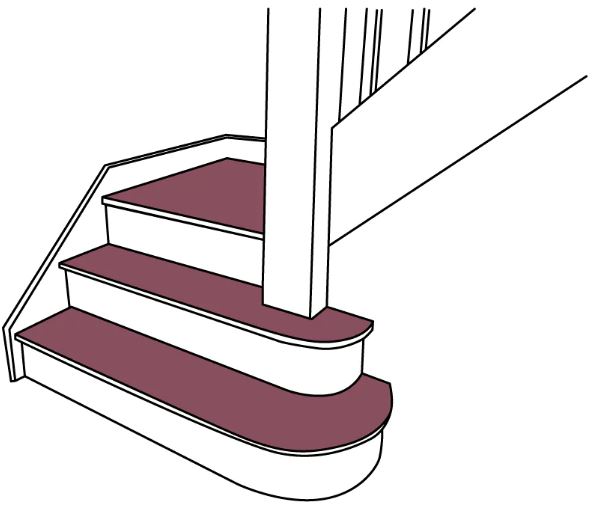
- You don’t need a stair rail on the first two steps of a staircase, such as on bullnose steps, where the newel post is positioned on the third step (as shown in the diagram below).
- How many handrails are required:
- If the stairs are less than 1m wide, you provide a handrail on one or both sides.
- If the stairs are wider than 1m, you should provide a handrail on both sides.
- The correct diameter of a handrail:
- A circular handrail in a domestic property should be between 32mm and 54mm in diameter.
- A non-circular or oval handrail should be 50mm wide and 39mm deep with a radius of at least 15 mm.
How to measure the height of a stair handrail
To meet building regulations, make sure you fit a new handrail between 900mm and 1000mm above the pitch line of the stairs. The pitch line is a virtual line that sits on top of the stair nosing at the edge of the treads.
A stair tread is the horizontal part of the step on which you place your foot (or ‘tread’) when you climb the stairs.

When you’re measuring the stair handrail height, don’t forget to take into account the diameter of the handrail too. For example, if you’re installing a 54mm Mopstick handrail, you’ll need to deduct 54mm from the overall height measurement.
Find out more information on how to measure your staircase rail here with our complete guide.
Recommended handrail product: Oak cottage loaf handrail – 41mm groove
What height should a handrail be on a landing?
The handrail height on a landing should be the same as it is on a staircase—900mm and 1000mm above floor level, rather than the pitch of the stairs.
To enhance the look of the landing and staircase, make sure you are choosing the right handrail design. Find out more about the stair handrail design options here.
What other building regulations apply to staircase parts?
Handrails form just one part of your staircase. To ensure your staircase is safe, you’ll need to consider the other stair parts covered by Part K of the Building Regulations. Treads and risers are key staircase parts directly related to handrail height:
Staircase treads and risers
A riser is the vertical section between each tread on a staircase. It should be between 150mm and 220mm high, or 165mm and 200mm, and be at a consistent height on every step.
|
|
Riser |
Going |
||
|---|---|---|---|---|
|
|
Minimum (mm) |
Maximum (mm) |
Minimum (mm) |
Maximum (mm) |
|
Private |
150 |
220 |
245 |
260 |
|
165 |
220 |
223 |
300 |
|
Building regulations define ‘the going’ of a step as the tread depth from the front to the back of a step, minus any overlap from the tread above.
Some staircases have open risers, which have their own building regulation requirements. Open risers should:
- Overlap treads by 16mm.
- Be constructed so that a 100mm-diameter ball cannot pass through them.

Recommended stair cladding product: Stair Cladding Pre-Finished Oak Tread with Reversible Riser 1000mm
High-quality handrails by Jackson Woodturners
At Jackson Woodturners, we offer the largest selection of modern and traditional stair parts in the UK. Our range of stunning high-quality handrails makes it easy to renovate your staircase and we have plenty of guidance to help you follow UK building regulations. We offer ungrooved handrails, mopstick handrails and pigs ear handrails, as well as a selection of handrail brackets, end caps, fittings and wall mounted handrail kits.
If you’re still unsure about the correct handrail height or confused about how to measure the pitch line of your staircase, our staircase experts will be happy to help you out with some advice.
View our full range of handrails on our website. Alternatively, don’t hesitate to get in touch with our friendly team if you have any questions about handrail sizes. You can call our staircase experts on 0114 272 1228 or email [email protected]
Frequently asked questions about handrail requirements
How far apart should handrail brackets be?
Though there are no specific building regulations regarding stair handrail brackets, homeowners should consider how they finish the railing.
Browse through our handrail fittings here.
Where to measure handrail height from?
You should measure your handrail height from the pitch line of the stairs. This is an imaginary line that runs along the top of the stair nosing.
Use a tape measure to measure from the bottom step to the required height of your handrail, and then repeat the same process for the top step. You can use a spirit level to ensure your tap measure is completely vertical. To comply with building regulations your handrail should be between 900 mm and 1000 mm.
Is it illegal not to have a handrail on stairs?
Building regulations state that stairs less than 1000mm wide should have a handrail on at least one side. Stairs with a width of more than 1000mm should have a handrail on both sides.
Building regulations are not generally applied; so, if you do not currently have a handrail, it is not legally required. However, if you plan to sell your house or let your property, not having the correct handrails is likely to be a problem.
Bear in mind as well that not having the correct handrails could make the staircase unsafe or difficult for people to use, particularly if a flight of stairs has open sides.
The right handrail design can also enhance the aesthetic of the staircase and improve the overall look. Find out more information about the different stair handrail designs here.
Are handrails required on both sides of stairs?
If your stairs are wider than 1000mm, you’ll need a handrail on both sides of the stairs.
Can I remove a handrail from my staircase?
You can, but this may cause problems when you come to sell your property. To comply with building regulations, staircases should have at least:
- one handrail if your stair width is less than 1000mm
- two handrails if your stairs are wider than 1000mm.
To find out more about handrails, visit the page Your Guide to Handrails.


