
Within this guide you'll find information on the following:
- What is a balustrade?
- Why are balustrades important?
- Parts of a balustrade
- Different styles of balustrade
- How to choose the right balustrade
- Measurements and building regulations
- Installation tips
- Style guide
Click here to return to Technical Guides.
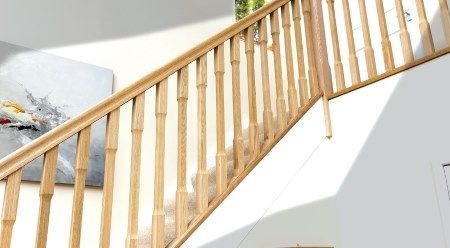
What is a balustrade?
A balustrade is the structure that encloses a staircase on one or both sides, commonly consisting of:
Together, these parts form a railing or wall that's designed to prevent people from falling off or down the staircase.
Why are balustrades important?
Balustrades serve a vital safety function, but they're important to design. From traditional to ornate to modern, the beauty of balustrades is that they can be used to make a real design feature of a staircase, or alternatively can blend seamlessly with the décor so as not to make too strong a statement.
Parts of a balustrade
Handrail
As the name suggests, the part that you hold on to while climbing or descending the stairs. It sits on top of the spindles or glass, depending on the type of balustrade being installed. It can also be used as a standalone product where it is attached to a wall.
Spindles
Spindles (also known as balusters) support the handrail and protect people from falling through the space between the handrail and the stairs.
Base rail
The part that sits on top of the stair string and to which the bottom of the spindles are fixed.
Newel posts
The vertical posts that sit at the bottom and/or top of the balustrade to support the handrail and secure the whole balustrade.
See our technical guides to key stair parts for further information on the different parts of a balustrade.
Different styles of balustrade
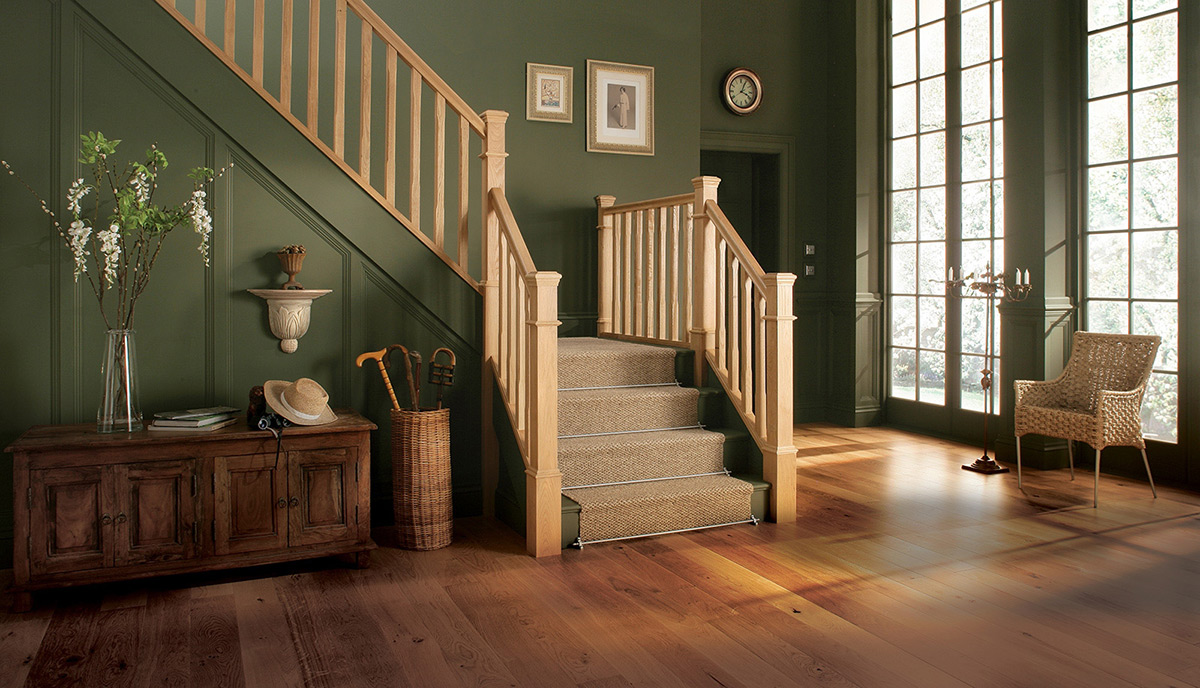
Traditional
A more traditional baluster would include classic elements such as carved wooden spindles and newel posts.
Ornate
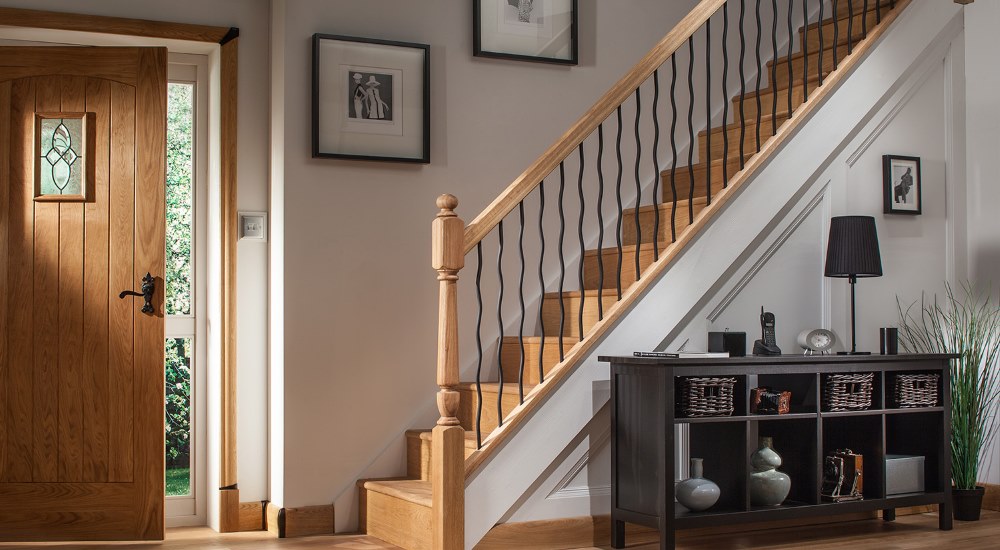
An ornately designed baluster makes a statement and may not include spindles at all, but instead incorporate intricate metalwork alongside more traditional elements.
Modern
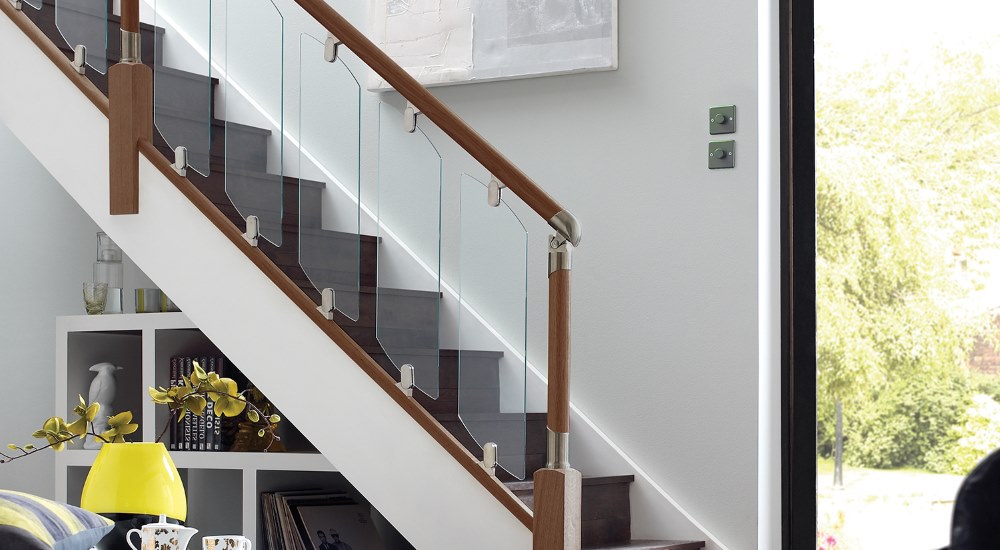
Modern staircase designs can include few to no elements of a ‘traditional’ balustrade, with materials like toughened glass opening lots of opportunities to create safe and light-enhancing structures.
Visit our online shop to see the full range of balustrade parts and styles we offer
How to choose the right balustrade
Choosing a balustrade for your staircase depends largely on the style and age of your home. You can find detailed advice on selecting the right material and style of balustrade for your home in this guide.
Measurements and building regulations
In order to keep your balustrade as safe and user-friendly as possible, there are a few UK building regulations to follow:
Height
The handrail in a domestic property should be no lower than 900mm on both stairs and landings. If this is a commercial property then handrail on the stairs is 900mm and 1100mm on the landing.
Weight
Handrails in domestic properties must be able to withstand 0.36kN/m (kiloNewton metres).
Width
Spindles must be placed close enough together that a 100mm sphere cannot be passed in between them.
Installation tips
- The handrail and base rail are usually the same length (unless the stairs are diminishing or cut string). Please see our guide, How to measure your staircase, to identify the type of staircase that you have.
- When renovating an old staircase it’s usually better to install a base rail for new spindles to fit into.
- You can use our handy spindle spacing guide to help you calculate the correct placement of the spindles.
- There are a number of helpful how-to videos on YouTube if you choose to install your balustrade yourself. However, it’s a big job that requires a high degree of accuracy and safety, so we would recommend employing an experienced professional if you’re at all unsure.
Style guide
If you’re planning to update your staircase balustrade and need inspiration, take a look at our style guide for design ideas.
Stair parts FAQs
What are your White Primed products made of?
Our white primed product are primed on a hardwood base, which tends to be either tulipwood or birch.
Are your White Primed products a finished item?
No, they are a pre-primed product, so they are ready to receive a final colour of your choosing.
As there are many variations of white, we cannot always guarantee the shade of our white primed products will be 100% to your liking, which is why it is called ‘White Primed’. We advise that a solvent-based top coat works best with our White Primed products rather than a water-based paint.
What is the best product to use on White Primed stair parts?
A solvent-based top coat adheres best to our white primed stair parts, rather than a water based paint. We would advise following the below steps prior to painting:
- Remove any loose coatings.
- Abrade the surface to provide a smooth finish.
- Dust and ensure the surface is clean and dry.
Do your stair parts come pre-finished?
The vast majority of our stair parts come unfinished. We offer some ranges that come pre-finished, such as Fusion, Axxys and Immix, and these are highlighted as being pre-finished in their descriptions.
Since our products are unfinished, you’re free to finish them once installed to the look you want with paint, stain or varnish. We advise finishing your wooden stair parts as they may discolour and stain over time if no finish is applied.
We offer a range of finishes by Treatex which protects and enhances the natural grain of your wooden staircase.
Can I use your stair parts outdoors?
No, our stair parts are designed for internal use only.
Does the infill/spacer come with the handrail and baserails?
All the handrails and baserails that we sell that have a groove in to take a spindle or slot for glass panels come with a compliment of infill (spacer or track).
Do you sell the infill/spacer separately?
No, all the infill/spacer/tracks we sell are pre-packed into our handrails and baserails.
I only want to order a small item; do I have to pay the £15 delivery charge?
If you order online then you will automatically be charged the £15 delivery rate (Monday –Friday all day service). If you call us to place the order over the telephone (0114 2721228) then we can look to do a reduced delivery rate dependant on the item(s) you wish to purchase.
Balustrades are an essential part of most homes and yet many people are unfamiliar with the term. If you’re renovating your staircase, you’ve likely heard the term used, but what exactly is a balustrade and what is its purpose?
A balustrade is a structure that runs alongside your stairs to prevent people from falling off. It consists of a handrail, spindles or glass panels, a base rail and newel posts. Not every staircase requires a balustrade. For example, if a staircase is fully enclosed by walls then only a handrail is needed for safety.
Keep reading for a more detailed explanation of what balustrades are and answers to your most common questions. In the rest of this guide, you'll find information on the following:
What is a balustrade?
A balustrade is the structure that encloses a staircase on one or both sides, commonly consisting of:
- Handrail
- Spindles (or balusters)
- Base rail
- Newel posts
Together, these parts form a railing or wall that's designed to prevent people from falling off or down the staircase.
Why are balustrades important?
Balustrades serve a vital safety function, but they're also important to design. From traditional to ornate to modern, the beauty of balustrades is that they can be used to make a real design feature of a staircase. Alternatively, they can blend seamlessly with the décor so as not to make too strong a statement.
What are the main components of a balustrade?
A balustrade is made up of four key elements: the handrail, spindles (or glass panels), the base rail and newel posts.
Handrail
As the name suggests, the handrail is the part you hold on to while climbing or descending the stairs. It sits on top of the spindles or glass panels, depending on the type of balustrade being installed.
Specific types of handrails, such as mopstick and pigs ear handrails, can also be used as a standalone product and attached to a wall. This is common in staircases where a full balustrade is not required because it is enclosed by walls.
Spindles
Spindles (also known as balusters) support the handrail and protect people from falling through the space between the handrail and the stairs.
A modern alternative to wooden or metal spindles is glass panels. These are installed in place of spindles and require a specific type of handrail called a glass grooved handrail or glass brackets and clamps alongside a normal handrail. Read our guide to glass balustrades for more information.
Base rail
The base rail sits on top of the stair string and is the part to which the bottom of the spindles are fixed. Base rails provide support and help to hold the balustrade in place.
Newel posts
These are the vertical posts that sit at the bottom and/or top of the balustrade. Newel posts help to support the handrail and secure the whole balustrade.
See our technical guides to key stair parts for further information on the different parts of a balustrade.
Different styles of balustrade
If you’re renovating your staircase, it’s essential to choose a style of balustrade that matches the interior design of the rest of your home and your personal preferences. Here’s an overview of the three main styles of balustrades.
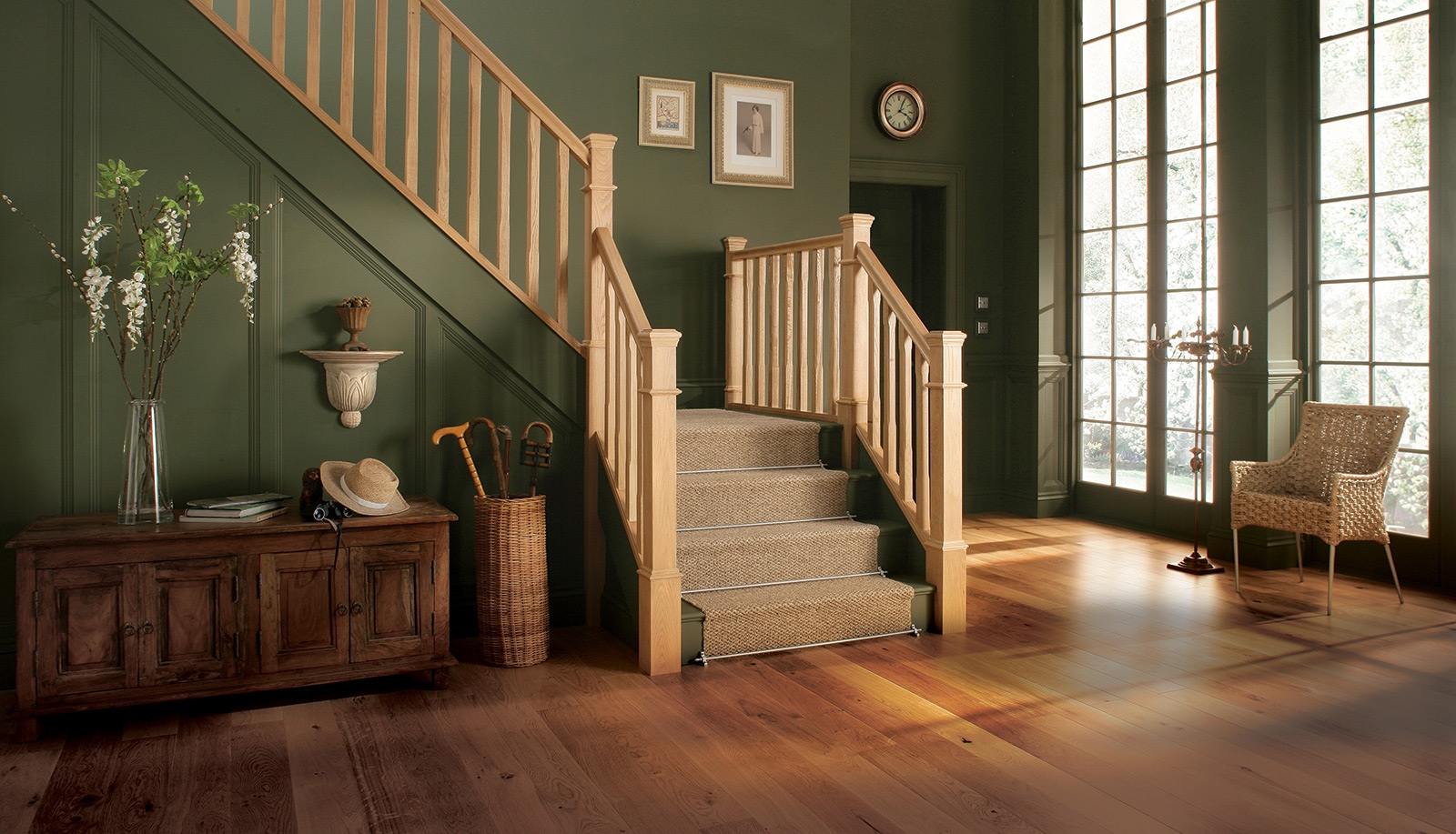
Traditional
A more traditional baluster would include classic elements such as carved wooden spindles and newel posts. For example, you might opt for traditional fluted spindles with matching fluted newel posts.
Ornate
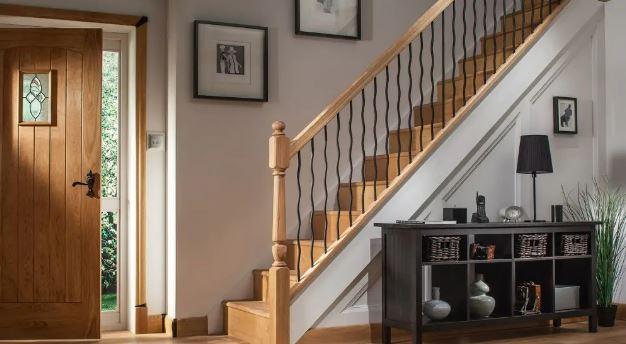
An ornately designed baluster makes a statement and may not include spindles at all, but instead incorporate intricate metalwork alongside more traditional elements. At Jackson Woodturners, we stock a range of ornate black metal stair parts, including these Richard Burbidge Black Metal Savannah Spindles which would add a real sense of character to any home.
Modern
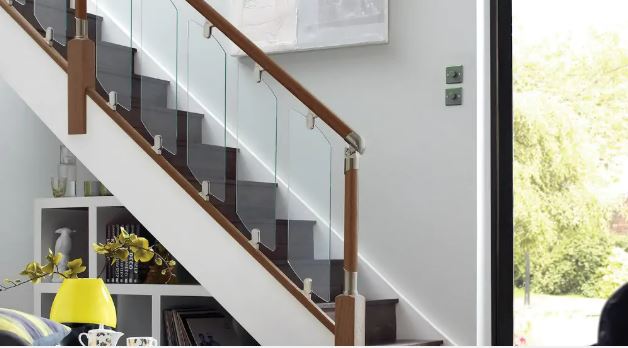
Modern staircase designs can include few to no elements of a ‘traditional’ balustrade, with materials like toughened glass offering lots of opportunities to create safe and light-enhancing structures. We offer a range of glass panels that are the perfect choice for more contemporary homes.
Visit our online shop to see the full range of balustrade parts and styles we offer.
How to choose the right balustrade
Choosing a balustrade for your staircase depends largely on the style and age of your home. You can find detailed advice on selecting the right material and style of balustrade for your home in this guide.
What are the building regulations for balustrades in the UK?
In order to keep your balustrade as safe and user-friendly as possible, there are a few UK building regulations to follow:
Height
If the handrail is in a domestic property, it should be no lower than 900mm on both stairs and landings. If it’s a commercial property, the stair handrail needs to be 900mm high and the handrail on the landing should be 1100mm high.
Weight
Handrails in domestic properties must be able to withstand 0.36kN/m (kiloNewton metres).
Width
Spindles must be placed close enough together that a 100mm sphere cannot be passed in between them.
How to install a balustrade: our top tips
If you’re planning on renovating your staircase yourself, here are our top tips to ensure the installation of your new balustrade goes as smoothly as possible:
- The handrail and base rail are usually the same length (unless the stairs are diminishing or cut string). Please see our guide, How to measure your staircase, to identify the type of staircase that you have.
- When renovating an old staircase it’s usually better to install a base rail for new spindles to fit into.
- You can use our handy spindle spacing guide to help you calculate the correct placement of the spindles.
- There are a number of helpful how-to videos on YouTube if you choose to install your balustrade yourself. However, it’s a big job that requires a high degree of accuracy and safety, so we would recommend employing an experienced professional if you’re at all unsure.
Style guide
If you’re planning to update your staircase balustrade and need inspiration, take a look at our style guide for design ideas.
Balustrades by Jackson Woodturners
At Jackson Woodturners, we offer the largest selection of contemporary and traditional stair parts in the UK. We stock a comprehensive range of high-quality balustrade components, including handrails, spindles, glass panels, base rails and newel posts. So if you’re looking to renovate your staircase, Jackson Woodturners has everything you could possibly need!
You can explore our full range of stair parts on our website. If you’re unsure which type of balustrades would be the right fit for your home, feel free to reach out to our team. We’ll be happy to offer recommendations or answer any questions you might have. You can call our staircase experts on 0114 272 1228 or email [email protected]
Balustrade FAQs
What is the difference between a bannister and a balustrade?
A bannister is the handrail on a staircase and forms part of the balustrade. The term balustrade refers to the entire structure and includes the handrail, baserail, spindles and newel posts.
What is the difference between a balustrade and a railing?
A railing is typically one continuous structure that is used to prevent people from falling off a deck or another raised surface. In comparison, a balustrade is composed of various elements and is used to protect people on staircases, terraces and balconies. Typically a railing will have a simple design and is more focused on functionality, while a balustrade can be incredibly ornate and has a practical and aesthetic purpose.
What is the history of balustrades?
Balustrades have a long and varied history. The earliest examples of balustrades are from ancient sculptural murals in Assyria (an ancient Mesopotamian civilization) that are dated somewhere between the 13th and 7th centuries BC. However, the Renaissance period is when balustrades became much more popular and commonplace, particularly in Italian palaces.
Where did the term balustrade originate?
The origin of the term balustrade comes from the Italian word ‘balausta’ which translates to wild pomegranate flower. This is because traditional balusters (known more commonly now as spindles) were shaped similarly to a partially opened pomegranate flower or bud.
How do you calculate balustrade spacings?
It can be difficult to calculate the spacings between your balusters or spindles when renovating your balustrade. Our easy-to-use spindle spacing guide is the simplest way to calculate the correct placement of your spindles and ensure you order the correct number.
Do you need planning permission for a balustrade?
Planning permission for a staircase balustrade will not be required if you are renovating your existing staircase. The only exception would be if the balustrade is part of a larger building project, such as an extension, which would likely require planning permission.


