
The staircase is often the focal point of a hallway. It can be viewed from many aspects, leading the eye from one space to another. The architecture of this area has huge potential for various types of lighting. Illuminating your staircase provides an opportunity to highlight architectural features and enhance texture in the space. It ensures your staircase creates a memorable and striking impact. Effective staircase lighting can also prevent accidents as visibility can be improved.
We spoke to Jo Mann, founder of Light House Designs and Juliette Thomas, founder of Juliettes Interiors for their tips on different ways to illuminate your staircase...
Lighting underneath the lips of stairs creates a minimalistic mystery
If you are interested in modern, minimalistic lighting - illuminating the lip of steps is a clever way to achieve this. Lights underneath the lip of a step or beside them can create a minimalistic, sleek look, as the fitting is hidden.
This lighting option creates a dramatic glow on the treads below. Placing lights in this way allows you to take advantage of any bends and edges to plot a textured lighting scheme. This style may require the assistance of a professional for correct fitting, however, the result will be aesthetically pleasing and authentic.
Juliette Thomas states: “Hidden lighting that shines gently across or underneath the treads of your stairs will highlight the beautiful materials used. Small uplighters can be used to draw the eye to bannisters and vertical elements. Soft or coloured lighting adds an extra dimension. This must be in a style to complement your staircase, not fight with it.”
Lighting just the staircase riser creates a glare-free, subtle, and soothing atmosphere. This is ideal if you are seeking lighting that isn’t too harsh or bright.
Juliette adds: “Lighting needs to be used sympathetically to enhance the overall feel. Soft lighting creates a warm, welcoming mood while cool lighting provides a contemporary and airy feel.”
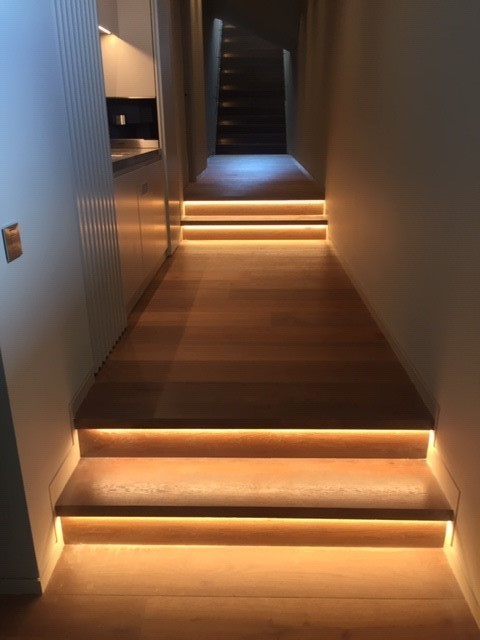
(Image: www.light-housedesigns.com)
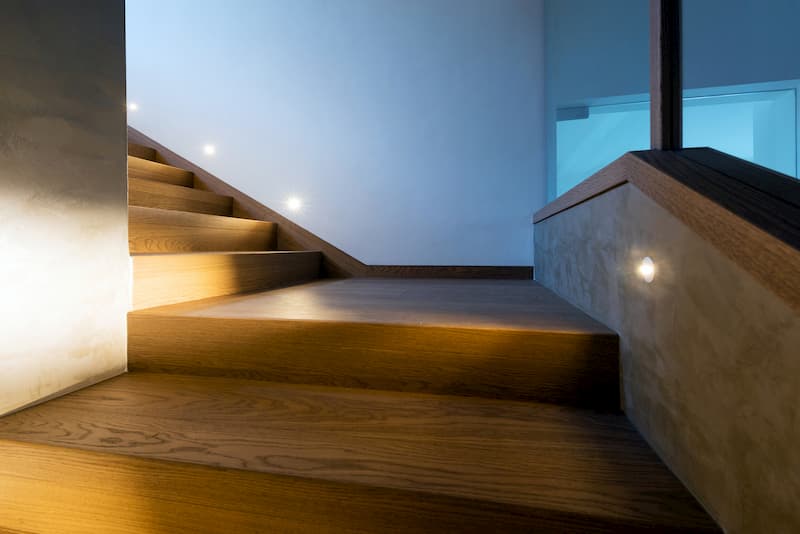
Lighting attached to the wall can emphasise details of a staircase
Wall lights work particularly well on timber staircases, as they can complement the colour and texture of the wood. They can help draw your eyes to each tread. Wall lighting also adds decorative elements whilst providing a good general glow of light. If your staircase is designed from wood that has a warm colour, cooler lighting can complement the wood whilst creating an eye-catching contrast.
Jo Mann shares her tips on complementing the textures of a staircase:
“If you place a light fitting near to the surface of the stairs, the light will skim across, picking up the texture. The closer the fitting to the surface, the stronger the effect. You can use square or round step lights to wash across the tread, or uplights underneath an open staircase to uplight a textured wall.”
To avoid harsh glares, avoid installing wall lighting above every step. This ensures your staircase lighting isn’t too busy and doesn’t overpower the architectural details of your staircase.
Jo adds: “Small lights tend to be more discreet, so are preferable in my opinion. There are some beautifully designed products which have a baffle or a deep recess and this really helps to hide the source of light. Small lights are best set every second or third step, centered in the stringer.”
Make use of high ceilings with a classic statement chandelier
A feature lighting or central chandelier can be installed as an artistic statement or simply complement the surrounding décor within a home. A chandelier can be a good addition if you want lighting that doesn’t alter the staircase design.
Jo explains how a chandelier combined with step lights can create impact:
“Choosing a stunning pendant/chandelier to hang over a stairwell, paired with low-level step lights, will create an interesting effect.”
If you have a high ceiling, a chandelier is a good way to take advantage of the extra space. High ceiling lighting often needs a large item as small lighting may look disproportionate. To achieve the best possible effect, your chandelier needs to be the right size for complementing your staircase.
Juliette advises: “Personally, I love a striking chandelier, modern or traditional, but too big and it will overpower your staircase. Too small and your lighting will look insignificant, more like an afterthought. Plan your lighting as part of your staircase design.”
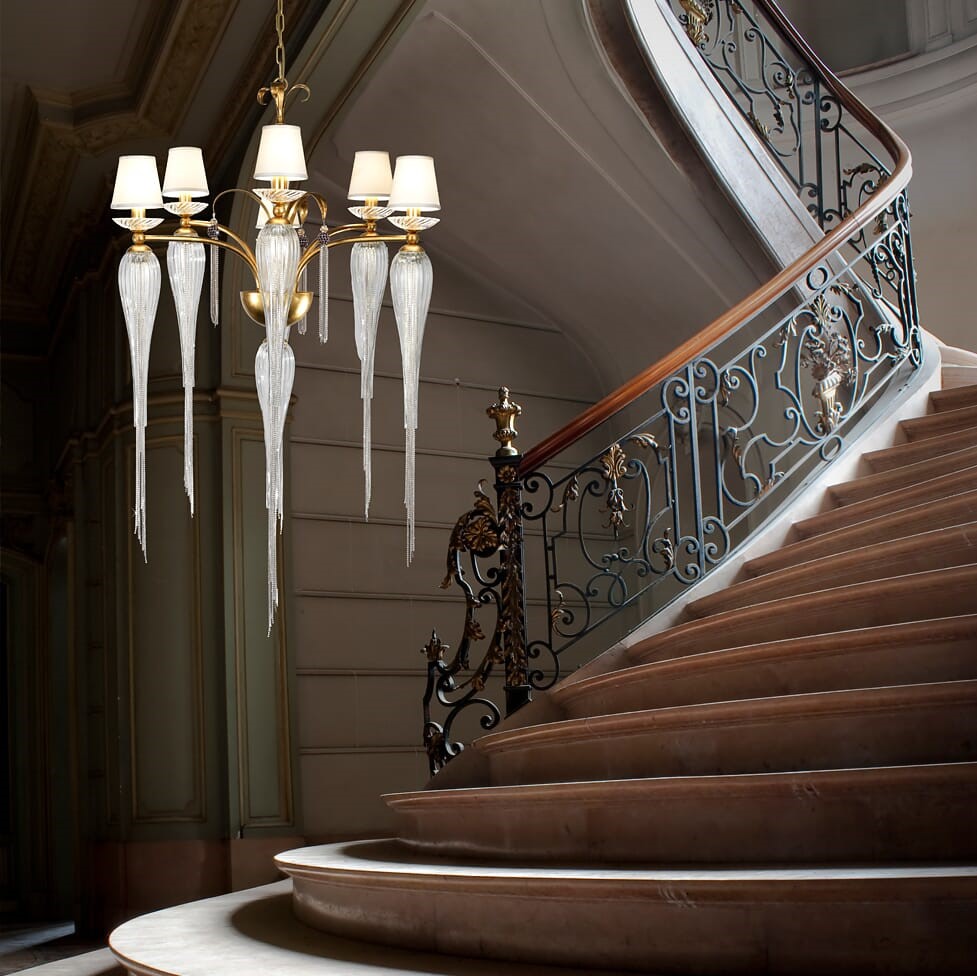
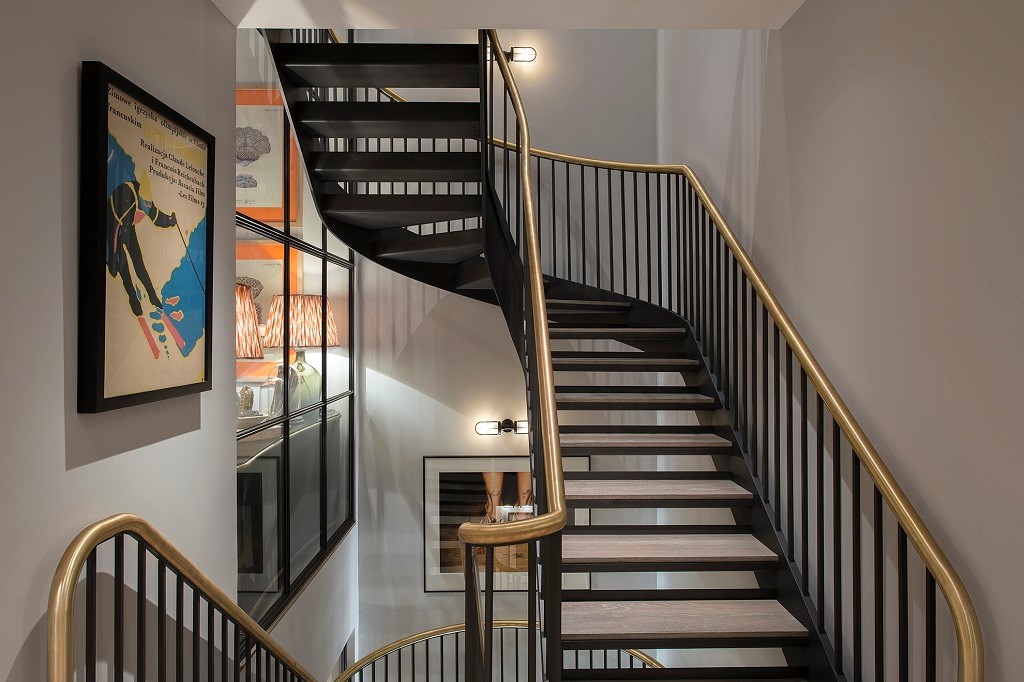
(Image: https://light-housedesigns.com/).
Consider the safety factors of lighting for children
Although lighting creates a statement, a key function of staircase lighting is for navigation purposes – particularly if the surrounding lighting is dim. This function is especially important if you have children. Juliette advises: “Never forget that whatever lighting you choose, you must be able to see your way up and down the stairs. If your overhead or wall lighting is very subdued, consider adding lighting to the steps for safety. If it is within the reach of children, make sure you use LED lighting so there is no heat for little fingers to get hurt.”
Motion sensing stair lighting is ideal for ensuring your staircase is safe for children. It is also a great way to conserve your electrical energy expense budget plan, as the lights will only turn on when someone walks up the stairs
Built for safety, motion sensing stair lighting consists of a small battery-powered box with a motion sensor inside. When a person walks up to the light, it immediately activates to ensure safe access to the stairwell.
Light up your handrail to create a charming streak of light
Using a LED strip to light up your handrail can create a warm streak of light that will accompany you up the staircase. Installing LED strips is also a method that can be done with a small budget, so it is a great alternative if you are looking for an affordable way to illuminate your staircase.
Juliette provides her tips on experimenting with handrail lighting:
“LED strip lighting is a great addition to your staircase - bringing out the texture of the handrail, adding a sense of floating, and the added safety aspect. Experiment with different colour LEDs or even multi-coloured, changeable strips that can change the mood at the touch of a button with very little budget.”
Lighting the handrail is also a great way to improve safety at night without the effect being too overwhelming.
The staircase is often the focal point of any hallway, leading the eye from one space to another. They offer huge potential for various types of lighting, with a variety of opportunities to highlight architectural features and enhance texture. Effective staircase lighting not only creates a memorable and striking impact but also prevents accidents with improved visibility.
So, what are the different ways you can light up a staircase?
There are several ways you can illuminate your staircase, each suited to its own aesthetics and function. This includes:
- Under-lip lighting
- Wall-mounted lighting
- Classic statement pieces
- Illuminated handrails
- Lighting for safety
In this blog, we’ll run through our tips from Jo Mann, founder of Light House Designs, and Juliette Thomas, founder of Juliette’s Interiors, on the different ways to illuminate your staircase.
Under-lip lighting
If you’re interested in a modern and minimalistic look, adding lighting to the lip of your steps is the perfect option. Whether you choose to install lights underneath the lip of the step or to the side, you’ll be able to hide the fittings to maintain a sleek aesthetic.
Under-lip lighting creates a dramatic glow on the below treads, and placing the lights in this way allows you to take advantage of bends and edges to create a textured lighting scheme.
To properly execute this style of lighting, you may need the assistance of a professional to make sure everything is safe, tidy, and clean.
“Hidden lighting that shines gently across or underneath the treads of your stairs will highlight the beautiful materials used. Small uplighters can be used to draw the eye to bannisters and vertical elements. Soft or coloured lighting adds an extra dimension. This must be in a style to complement your staircase, not fight with it.”
-Juliette Thomas
Lighting only the staircase riser creates a glare-free, subtle, and soothing atmosphere, ideal for those seeking lighting that isn’t too harsh or bright.
“Lighting needs to be used sympathetically to enhance the overall feel. Soft lighting creates a warm, welcoming mood while cool lighting provides a contemporary and airy feel.”
-Juliette Thomas
(Image: https://light-housedesigns.com/).
Wall-mounted lighting
Wall-mounted lights work particularly well for timber staircases, as they can complement the colour and the texture of the wood nicely. They can help draw your eyes to each tread, whilst adding decorative elements and providing a good glow.
If your staircase is made from warm-toned wood, cooler lighting can both complement the wood and create an eye-catching contrast.
“If you place a light fitting near the surface of the stairs, the light will skim across, picking up the texture. The closer the fitting to the surface, the stronger the effect. You can use square or round step lights to wash across the tread, or uplights underneath an open staircase to uplight a textured wall.”
-Jo Mann
To avoid harsh glares, avoid installing wall-mounted lighting above every step. This ensures your staircase isn’t too busy and doesn’t overpower any architectural details.
“Small lights tend to be more discreet, so they are preferable in my opinion. There are some beautifully designed products which have a baffle or a deep recess, and this really helps to hide the source of light. Small lights are best set every second or third step, centred in the stringer.”
-Jo Mann
Classic statement pieces
If your staircase features a high ceiling, a feature piece or a central chandelier can be a great addition if you don’t want to alter the stairs themselves. Chandeliers are a good way to take advantage of extra space, making the area feel more proportionate than smaller lights. To achieve the best possible effect, your chandelier needs to be the right size for your space.
“Choosing a stunning pendant or chandelier to hang over a stairwell, paired with low-level step lights, will create an interesting effect. Personally, I love a striking chandelier, modern or traditional, but too big and it will overpower your staircase. Too small, and your lighting will look insignificant, more like an afterthought. Plan your lighting as part of your staircase design.”
-Jo Mann
Illuminated handrails
Using an LED strip to light up your handrail can create a warm streak of light that will travel with you up the staircase. This method is also typically more suitable for a small budget, so it’s a great alternative if you’re looking for a more affordable option. Handrail lighting is also a great way to improve safety at night, without making the lights too overwhelming.
“LED strip lighting is a great addition to your staircase - bringing out the texture of the handrail, adding a sense of floating, and providing the added safety aspect. Experiment with different colour LEDs or even multi-coloured, changeable strips that can change the mood at the touch of a button with very little budget.”
-Juliette Thomas
Lighting for safety
Although lighting is often used to create a statement, it’s important to keep its key function in mind - navigation. This is especially important if the lighting in the surrounding area is dim and you have children in the home.
“Never forget that whatever lighting you choose, you must be able to see your way up and down the stairs. If your overhead or wall lighting is very subdued, consider adding lighting to the steps for safety. If it is within the reach of children, make sure you use LED lighting so there is no heat for little fingers to get hurt.”
Stair lighting with motion sensors is ideal for making sure your staircase is safe for children. It’s also a great way to conserve energy and save money, as your lights will only turn on when they sense traffic.
Bring your staircase to life with Jackson Woodturners
The right staircase lighting works wonders when paired with high-quality stair parts. Whether it's handrails and spindles, or newel posts and caps, well-crafted stair components, like those available at Jackson Woodturners, work with your lighting to enhance not only your design, but safety too.
Choose from our huge range of premium stair parts today to make sure your staircase renovation is cohesive, polished, and stands the test of time. Alternatively, get in touch with our expert team to find out more about how we can transform your home.
Staircase lighting FAQs
Why is staircase lighting important?
Staircase lighting improves your staircase in two key ways:
- Safety: Reducing the risks of trips and falls by illuminating stairs and highlighting depth.
- Aesthetics: Highlighting architectural features and adding a warm ambience.
Which kind of staircase lighting is right for me?
The type of staircase lighting you choose will depend on your desired style, budget, and lifestyle. Several factors will dictate your choice, including:
- Light temperature: Warm whites will create a cosy atmosphere, while cool whites will add a modern touch.
- Switch options: A simple on/off switch will be ideal for most staircases, but you can take it to the next level with dimmable lights - allowing you to create different moods.
- Budget: Some options, like LED strips, will be cheaper than others and can be installed without major structural changes.
- Placement: Choose lighting that illuminates the steps themselves, not just walls, to avoid strong shadows.
Can I install stair lighting myself?
Some staircase lighting options will be DIY friendly, but it's important to know that help from a professional will likely get the best results for your staircase renovation.
For example, LED strips can often be installed without any major structural changes, but may give a less polished look than professionally-installed lighting.


