
Stair newel posts are one of the most important aspects of your staircase that often go underlooked. Not only are they decorative pieces that are one of the first things a guest will see when entering your home, they’re also important to the structural integrity of your staircase. So what is a stair newel post?
A stair newel post is the vertical post that sits at the end of your balustrade, providing support and structure to your bannister. This provides strength to the entire staircase and holds it in place, while also being a decorative piece that draws attention to your staircase.
Read on to find out more about what stair newel posts are, what types and styles are available, what materials you can choose from and more.
What is a stair newel post?
A newel post is the upright post that sits at the top and/or bottom of the balustrade to support a staircase bannister and secure the balustrade. Newel posts don’t just give a balustrade structure and strength, they also offer the perfect opportunity to add a decorative touch to your stairway.
Stair newel posts can vary in design from traditional to contemporary to reflect the style of the staircase and interior décor. They are available in a huge range of materials, with popular choices being oak, pine and hemlock.
What types and parts of newel posts are available?
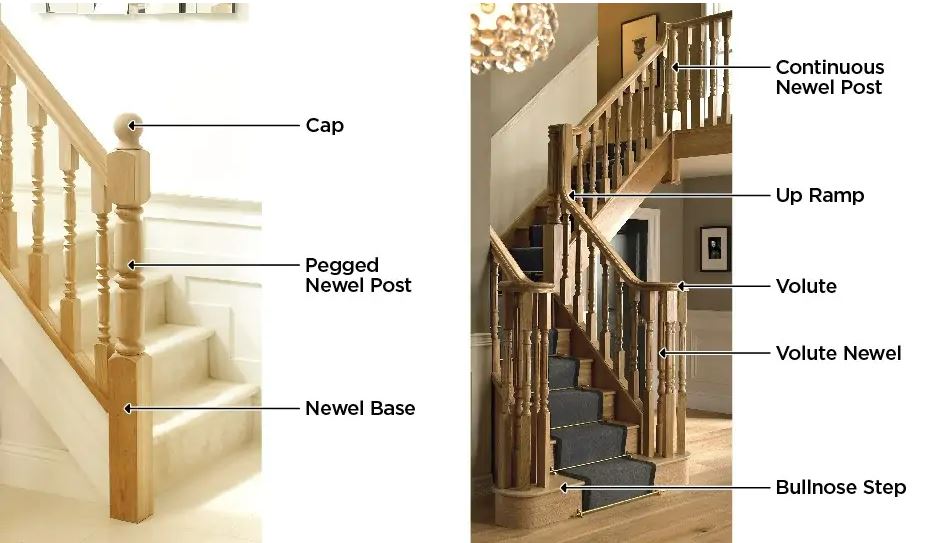
Newel posts can be either a complete post or three separate elements:
- Newel base
- Newel post
- Newel cap
This breakdown of the separate elements will help you determine what parts you need to suit your particular staircase.
Complete newel post
These incorporate the newel base and newel post to make a complete unit. In some cases, a newel cap is already attached.
Newel base
The square part at the bottom of the newel post. It has a shaped top and a pre-drilled 50mm hole. The 50mm diameter peg on the newel post sits inside this hole. If you’re cutting down an existing newel post, don’t cut it too short as newel posts come in fixed lengths.
Pegged newel post
Generally, the pegged newel post is the more decorative part of the post. The post has a 50mm diameter peg (also known as a dowel) on the bottom, and the post peg fits into a 50mm hole in the newel base.
A newel post is always a fixed length usually 750mm–850mm long (excluding the peg). The newel base makes up the remainder of the height of the newel post.
Pegged newel posts are ideal if you can’t easily remove the existing newel base from your staircase, but want to update the look of your newel.
Newel post half
Used on landings where the end of the balustrade meets a wall, a half newel post is the ideal way to finish off the balustrade, adding extra strength and a smart finish. Half posts attach directly to the wall and sit flush against it. When changing newels on a staircase, it’s often easier to change the half newel completely.
Volute newel posts
This type of newel post sits on the bullnose step at the foot of a staircase. It’s to be used in conjunction with a volute handrail fitting and 1100mm-long spindles.
Continuous newel posts
This style of newel is used along with handrail fittings to create a continuous flowing handrail across the top of the newel post. Rather than having a square head at the top of the newel, it has a round peg which sits in a hole on the corresponding handrail fitting.
What styles of newel post are available?
As well as choosing the type of newel post you want, you’ll also have to make a decision on the style that’s right for your home.
There is a huge range of options available, from the more traditional turned newel posts to the contemporary square or square twist styles.
If you’re not sure which style is right for you, read our guide What styles of newel post are available?
What material options are available for newel posts?
Newel posts are usually made of wood, with white primed, hemlock, pine, and oak newel posts being the most popular.
Oak Newel Posts
Oak is a hardwood, which means it’s extremely tough and resistant to dents and scratches. Its distinctive tiger-stripe grain makes oak newel posts a great, eye-catching addition to traditional or modern homes.
View a White Oak Stop Chamfered Newel Post here. You can find out more about oak newel posts and stair parts by reading our frequently asked questions here.
Hemlock Newel Posts
Hemlock is a softwood but it’s actually denser and stronger than many hardwoods. Its strength, combined with its uniform, knotless grain, makes it an excellent choice for a beautiful newel post. Hemlock newel posts tend to be less expensive than oak newel posts, but more expensive than pine.
View a Hemlock Stop Chamfered Newel Post here.
Pine Newel Posts
Pine newel posts are among the most affordable options for updating your newel. Pine is a softwood, which means it’s more susceptible to wear and tear. Pine newel posts do have some very strong benefits though—pine is quick-growing, so is one of the most sustainable woods available. It’s also very easy to paint, stain or varnish, so you can easily achieve the finished look you want.
View a Pine Stop Chamfered Newel Post here.
Other Options
Other materials for newel posts include ash, dark hardwood & walnut. You can read more about the differences between these woods, and the pros and cons of each, on the following pages:
- Choosing the right material for your balustrade
- Hardwood vs softwood: which is best for your wooden stair parts?
What are half newel posts?
Half newel posts are used to attach a balustrade to a landing wall. They also provide an attractive finish to the balustrade and help to tie-in the overall look of the staircase.
You can find out more about what half newel posts are with our guide Half newel posts - what they are, what they’re made of and how to fit them.
What fixings and accessories will I need for newel posts?
Before you begin choosing a newel post, you’ll need to know whether you’re replacing the newel post completely or keeping the existing newel base and attaching a new newel post on top.
If you’re attaching a new newel post to an existing newel base, you’ll need to drill a new 50mm hole into the existing base before you can fit the peg to the newel post. You can do this with a 50mm drill bit or hole saw.
If you’re replacing the newel completely, you can do this either by using the zip bolt newel post fastener or by fixing below floor level.
It’s essential that you attach the newel post securely as it needs to endure a lot of wear and tear. Below, we look at the individual parts needed to make up a newel post.
What are newel caps?
Newel caps are the small blocks of wood (or sometimes metal) that sit on top of newel posts. They provide a finishing touch to the newel post and offer extra support to people using the staircase.
Newel caps are an integral part of a newel post and you can find out more about how to choose the best one for your staircase with our guide, Newel caps—what they are, what styles are available and how to fit them.
If you already have a newel cap that needs fitting, read our guide, How to replace newel caps.
How can I fix a wobbly newel post?
Wobbly newel posts can be annoying and dangerous. If your newel post becomes loose, you should be able to fix it yourself with these top tips from a staircase fitting expert.
If you’re not an experienced DIY-er, always ask an expert to help!
Stair newel posts with Jackson Woodturners
At Jackson Woodturners, we stock a range of stair newel posts in a wide range of materials including ash, dark hardwood, and hemlock, with a range of styles such as solid or box newel posts.
Our team of stair part specialists have over 40 years of combined experience, so you won’t find better advice about stair parts and staircase designs anywhere! Get in touch with a member of our friendly team today for help with your next staircase project or choosing the perfect stair parts.
Newel post FAQs
What is the difference between a newel and a newel post?
While these names are sometimes interchangeable, a newel is a central column that supports a spiral staircase, with the column running through the centre. A newel post on the other hand, is a decorative post that is found at either end of a bannister, that provides structural support as well as being an attractive way to finish off your balustrade.
How far apart should newel posts be placed?
As newel posts sit at either end of the bannister, there’s no real limit as to how far apart they should be. In between the newel posts, structural support is provided by spindles, which should be a maximum of around 6 inches apart to ensure that there is enough support to secure your bannister.
Do newel posts go before or after flooring?
As your newel posts will be set into and on top of the floor, you will need to place your flooring down in advance of installing your newel post. Once the flooring is in place, you can drill into the flooring in the correct position and insert your newel post into the floor to secure it.
When would I use a double block newel post?
A double block newel post is used where there is a quarter landing on a staircase. It has two square heads.
The handrail coming up the stairs goes into the bottom block. As you turn through the quarter landing, the handrail going up the next flight comes out of the top block.
When would I use a winder newel post?
A winder newel post is a shorter-length newel post, used when the staircase has a kite winder. The handrail coming up the stairs will hit into the square newel base. As you go round the kite on the stairs, you’re changing heights, so the handrail going up after the kite will come out of the square block on the winder newel post.
Top tip: You should use a long newel base with a winder newel post.
What is the size of the peg on the newel post?
The peg on a newel post is 50mm in diameter, which will fit perfectly with any newel base to ensure that it’s secure and fits correctly. Always double check the measurements of both to ensure that they follow the industry standard and will fit together correctly, otherwise the structural integrity of your balustrade could be compromised.
Does your newel post measurement include the length of the peg?
No, the newel post measurement does not include the length of the peg. This is because the peg on a newel post sits in the hole in a newel base and doesn’t add to the height once installed.
What building regulations affect newel posts?
When you buy and fit new stair parts, you need to be aware of the building regulations related to stairs and ensure you comply with these.
Building regulations stipulate that a domestic property can have a handrail height of 900mm for both stairs and landings. Commercial properties should be a minimum of 900mm on stairs and 1100mm on landings.
When fitting your newel posts, you need to ensure there is sufficient room for the handrail to be fixed into the newel post at the correct height.
What else are newels used for?
Newels are also used as supporting pillars to provide structural support to spiral staircases. When used in this context, newels are also known as a central pole or a support column. While the primary concern is to support your balustrade, they can also be highly decorative pieces that will grab attention and make your staircase stand out!


