
Your complete guide to stair spindles
If you’re in the process of a new build or renovation and are looking for more information about stair spindles, you’ve come to the right place! In this article, our stair experts discuss everything you need to know about stair spindles, from types and materials to fitting and maintenance. So, first things first, let's find out what stair spindles are and where they are located?
Stair spindles, also known as a baluster, are the vertical posts that connect the base rail and handrail on a staircase. They form part of the balustrade, the collective name given to the base rail, handrail, newel post and spindles.
Keep reading to learn more about staircase spindles and where to find any extra information you might need.
How to choose the right type of stair spindle?
At Jackson Woodturners, we believe that a striking staircase can be an eye-catching centrepiece for your home. More often than not, it is the little details like the stair spindles that add this element to a staircase. Stair spindles vary in design, from traditional wooden spindles to contemporary metal designs. Before selecting new stair spindles, remember to ask yourself the following questions to ensure you choose the right stair parts for the job:
Is your staircase closed string or cut string?
Closed string staircases enclose the stair treads and risers. The spindles are fixed to a base rail at the bottom and there is a handrail at the top. Alternatively, cut string staircases leave the stair treads and risers exposed. The spindle sits directly on the stair tread. For this reason, you will need two spindles on each tread. The front spindle should be 900mm long and the back spindle 1100mm.
To find out more about choosing different spindle styles, take a look at our article, ‘Contemporary or traditional spindle styles - which is right for your home?’.
Does your staircase diminish?
A diminishing staircase is when the handrail going up the stairs hits the ceiling line. As the spindles hit the ceiling line, they begin to shorten in size.
What is the overall style of your property?
It’s crucial to remember that the style and period of your property also play an important part in your choice of spindle design. If you want to retain the property’s period features, a traditional wooden spindle may be more in keeping with the home than a contemporary metal spindle.
If you are looking for something more traditional, our pine stair spindles may be the choice for you. Our traditional pine spindle is part of the Pine range of modern and traditional stair parts. Take a look at our range of quality pine spindles here for further inspiration.
Who lives in your property?
Before choosing your stair spindles, you will need to consider who is using the stairs. If you have young children, a balustrade with sturdy spindles and a hard wearing finish is probably going to be your preference. Families with young children tend to choose spindles over glass panels, which can easily show fingerprints and smears.
According to experts, young professionals generally prefer metal spindles over glass panels. Older homeowners, on the other hand, tend to go for a classic contemporary look with a timeless feel, such as natural oak spindles.
What are the different types of spindles for stairs?
With a vast range of materials and styles available, stair spindles are often the most decorative part of a staircase. Let’s take a look in closer detail:
Materials
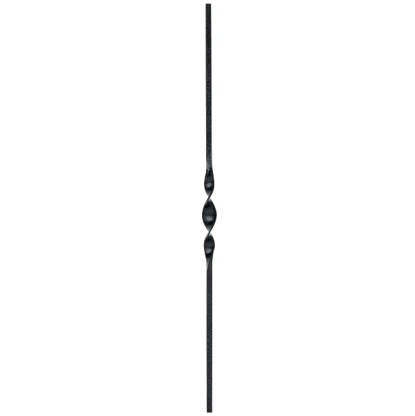
Metal Spindles
Metal spindles are becoming increasingly popular amongst individuals who wish to add a contemporary twist to a traditional property. The biggest advantage of metal spindles is that they’re extremely strong, durable and require very little maintenance. They also offer easy installation as some metal spindles have adjustable lengths and come with adjustable brackets.
Common materials for metal stair spindles include:
- Brushed nickel
- Brushed steel
- Chrome
- Black metal
Metal is a very versatile material that can work well with wood or metal handrails and base rails. What’s more, the wide variety of styles available means that you can pick a design as ornate or as simple as you want to suit your home and reflect your style. You can even mix and match metal spindles. For example, alternating simple straight spindles with ornate ones to create a truly unique balustrade.
One of our top tips for giving your staircase a total revamp is to replace timber spindles with iron spindles. This is because wrought iron contrasts perfectly with wooden stair parts to create a warm, welcoming stairway. Architectural interior designer, Louisa De Paola shares her recommendations:
“Bespoke wrought-iron spindles are a real statement and range in styles, so for a contemporary space, I’d specify a simple hairpin design in a matt-black finish. For a classic contemporary home, my favourite would be a sleek art deco design in an antique brass finish.”
View our full range of metal spindles here.
Wooden Spindles
Wooden stair spindles are a classic choice for staircases, especially in period properties. Wood is strong, durable and easy to paint if you decide to change the look of your wooden staircase.
Some of the most popular options for wooden stair spindles include:
- Oak spindles - This hardwood’s distinctive tiger-stripe make it instantly recognisable
- Pine spindles - A less expensive alternative to oak that is very easy to stain or paint
- Primed wood - This comes prefinished and is the ideal choice if you want to paint your spindles or have spindles with a crisp white finish
Find out more about the benefits of each type of material in our insightful article, ‘Choosing the right materials for your balustrade’.
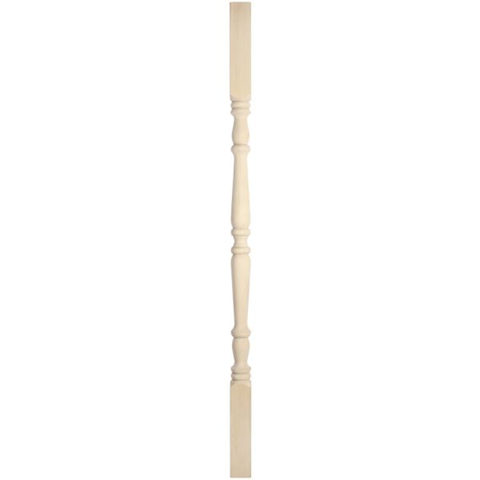
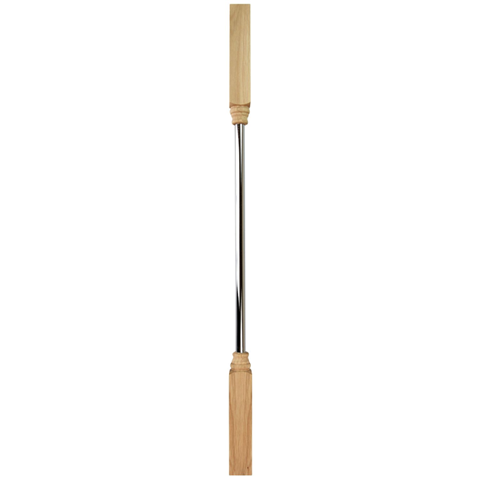
Oak & chrome
In order to utilise a mixture of styles, consider combining wood and metal together in your spindle design. Our Forge range fuses traditional timber with a solid modern set of modern fittings. This can enhance the staircase aesthetic and create contemporary elements with its spindles.
Our impressive Oak & Chrome spindle allows you to mix and match styles to create the perfect look for your home.
Styles
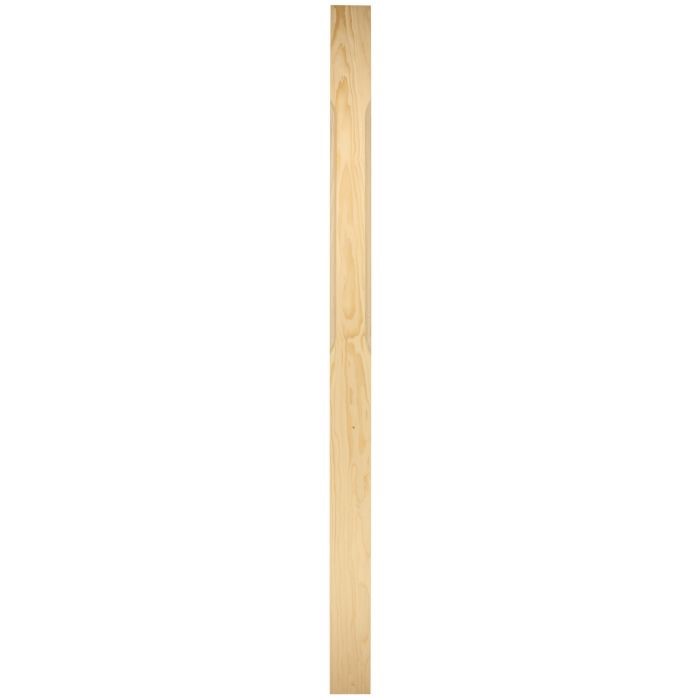
Square spindles
Square spindles are the simplest spindle design and are a popular choice for contemporary homes, particularly those with a minimalist style. The simplicity of square spindles tends to make them cheaper when compared with other designs, so are a great option if you’re updating your wood staircase on a budget, or if you plan to sell the property and are looking for a style with universal appeal.
This shape works well with the clean lines of chrome, the subtle warmth of oak or crisp white primed wood. When it comes to square spindles, we recommend our dark hardwood square plain spindle.
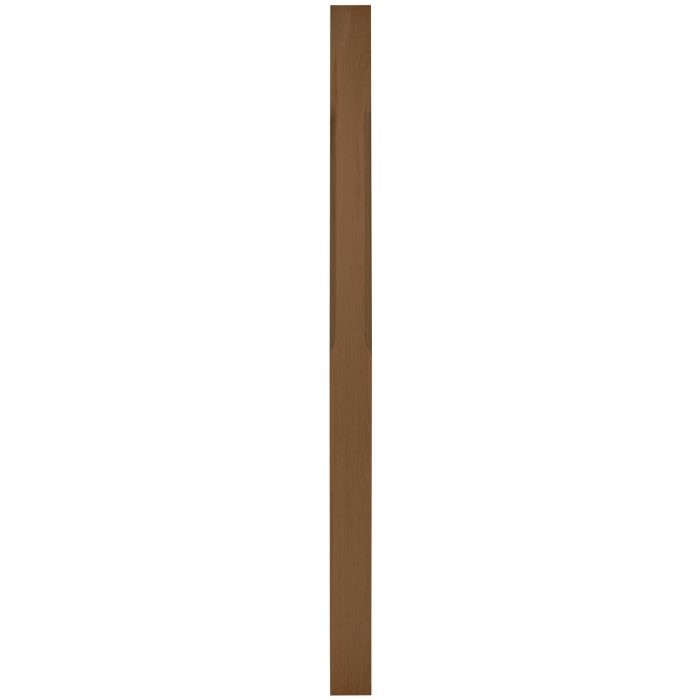
Chamfered spindles
Chamfered spindles are square at the top and bottom and have a narrower square decorative middle. They are similar in design and style to square spindles. The most popular materials include:
- Oak
- Pine
- White primes wood
The main benefit of chamfered spindles is that they suit modern and traditional properties. Because they are wooden, you have the freedom to paint or finish the balustrades to achieve the look you want. Our personal favourite is the Hemlock Stop Chamfered spindle.
Twist spindles
There are four main types of twist spindles, including:
- Barley twist spindle - Traditional style spindles where the middle of the spindle looks like the barley twist sweet, hence the name! Usually, they are made from wood but metal spindles are also available.
- Single twist spindle - Wooden square spindles with a simple twist in the middle to add interest. They are a popular choice for older homes and are available in wood and metal.
- Double twist spindle - Square spindles with a double twist in the middle. They are great for bringing a fresh look to a traditional home. The design features two twists in the metal, usually one in the top third and one in the bottom third of the spindle.
Take a look at our barley twist spindle recommendation to see why these stair spindles are so popular.

Colours
The colour you choose for your staircase spindles will help set the tone for the decor throughout your home, giving your visitors the right first impression.
To find out more, take a look at our informative article, ‘What Popular Spindle Colours Should You Consider For Your Staircase?’.
Spindle fitting and maintenance
What parts are required to work with spindles?
Stair spindles must be secured between a base rail and a handrail. Once you have made your choice on your spindle design, you can then select the right handrail and base rail to suit. Here is some of our top advice when it comes to stair spindles:
- Wood spindles sit in a grooved track in both the handrail and base rail.
- The size of the spindle (32mm or 41mm) will determine the size of this groove.
- Grooved handrails and base rails come with infill (also known as track or filler) which then sits between your spindles.
- Metal spindles tend to be used with a solid handrail and base rail.
- At either end of the run of spindles there will be a sturdier post, known as a newel post, which supports the entire balustrade.
What are the rules for stair spindles?
It is common knowledge that spacing stair spindles can be a difficult task. It is imperative that you get the spacing correct in order to ensure a secure balustrade and a safe journey up and down stairs. Placing stair spindles too far apart can result in a reduction in stability, the bannister becomes weak. Whereas, placing stair spindles too close together can result in a reduction in light, leading to an aesthetically displeasing staircase.
Building regulations state that gaps between stair spindles should not exceed 100mm. Domestic properties can have a handrail height of 900mm for both stairs and landings whereas commercial properties should be a minimum of 900mm on stairs and 1100mm on landings.
With this in mind, here are some very simple steps that can be made to make sure that your stair spindle spacing is even and well installed.
For the stairs, count the number of steps on a single flight, excluding the landing and multiply by 2 (to allow for two spindles per step). Then subtract 2 (as we only want one spindle on the top and bottom steps, to allow for the newel posts).
On the landing page, you will need to use a tape measure to record the length of the landing and the balustrade. To work out the length, you’ll want to subtract the landing length by 80. (We tend to use 80mm as the spindle spacing as it usually works best!) Top tip - make sure you round-up to the largest number if your calculation results in a decimal place.
How hard is it to change spindles on a staircase?
Changing your stair spindles does not need to be a difficult task as long as you follow the spindle spacing rules. For further support, why not check out our spindle spacing calculator to help you work out how many spindles you’ll need.
Is it best to restore or replace spindles?
Revamping a staircase with damaged spindles can make a huge difference to a home for both practical and aesthetic reasons. Depending on the condition of the existing spindles, there are different degrees of renovation that you may need to carry out. Before you start, ask yourself the following questions:
- Do I need to completely renovate all of the spindles? - When tackling a run-down staircase, it’s sometimes necessary to replace all of the spindles on the balustrade.
- Can I simply replace individual damaged spindles? - If only a few spindles are damaged, you can replace them individually. If you are in need of a bespoke spindle design, our expert woodturning service can easily replicate your existing spindles.
- Can I restore loose spindles rather than replace them? - Not only do loose stair spindles ruin the overall look of a balustrade but they also pose a danger to people using the staircase. If a spindle has split, you’ll need to replace it as soon as possible. Take a look at our expert advice on How to fix a loose wooden spindle here.
Finishing your spindles
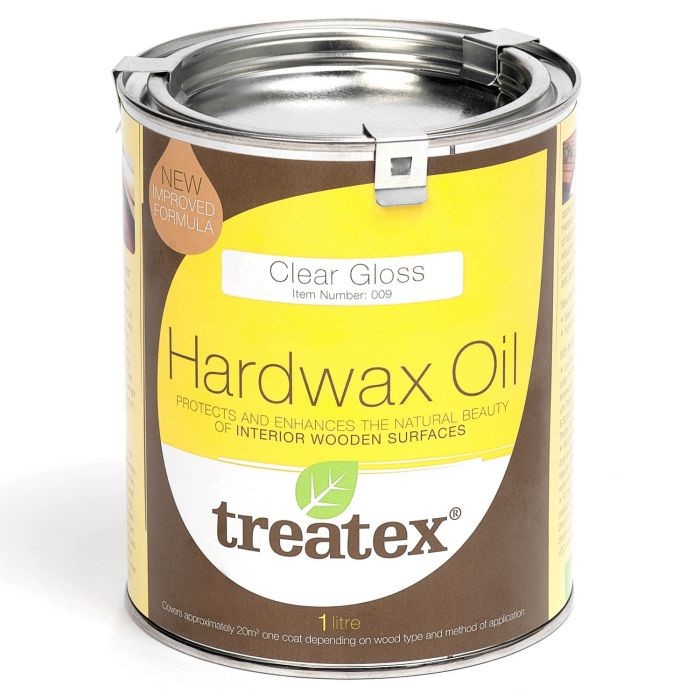
Sanding, painting and varnishing wooden spindles allows you to give your staircase a bespoke finishing touch. You may want to consider using our quality Hardwax Oil for a hard-wearing and attractive finish on your stair spindles.
Find out more about enhancing your stair spindles with our comprehensive guide, ‘Finishing Your Spindles - Spacing, Painting and Varnishing’.
Stair Spindles at Jackson Woodturners
At Jackson Woodturners, we stock a range of stair spindles in a wide variety of materials including ash, dark hardwood, hemlock, pine and white primed. These are available in a range of styles such as twisted, fluted, colonial, fluted and square. We also offer an extensive range of contemporary spindles which feature a more modern approach in their designs if you are looking for something slightly different.
Our team of stair part specialists have over 40 years of combined experience, so you won’t find better advice about stair parts and staircase designs anywhere! Get in touch with a member of our friendly team today for help with your next staircase project or choosing the perfect stair parts.
Stair spindle FAQs
What is the purpose of a baluster?
The purpose of the balusters, or stair spindles, is to support the handrail. They act as a direct safety measure to eliminate the risk of anyone falling, whilst adding aesthetically pleasing elements to the home.
Which spindle style is right for my home?
Whether you choose a contemporary or traditional spindle style will largely depend on your property type. However, with so many options available, we know it can feel daunting to know where to start. For more information about choosing between contemporary and traditional staircase spindles, take a look at our handy guide.
Is it illegal to have an open staircase?
Building regulations stipulate that a 100mm sphere (also known as the ‘babies head’ rule) should not be able to fit through the staircase at any point. This means that, generally open riser staircases cannot have fully open risers.
How far apart should bannister spindles be?
It is important to ensure that each spindle is accurately spaced along the balustrade. This will depend on whether you need spindles for the landing, the rake (stairs) or both, taking into account the width of the stair spindles themselves.


